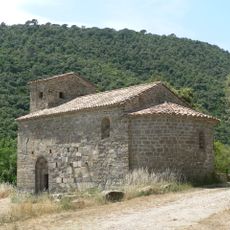
Sant Vicenç de Besalú, Romanesque church in Besalú, Spain.
Sant Vicenç de Besalú is a three-nave church with a transept and three semicircular apses, its central nave covered by a pointed barrel vault and the aisles by quarter-circle vaults resting on large square pillars. The south wall opens onto a late Romanesque portal with carved capitals and archivolts, while the west façade has a simpler Gothic portal with a pointed window above it. To the right stands a 17th-century bell tower with an octagonal upper storey.
Sant Vicenç is documented in 977, when Count Miró Bonfill ceded it to the church of Santa Maria; it was originally Besalú's parish church. The present building is probably the third or fourth rebuild, from the 12th to 13th centuries, with some Gothic elements. A 1420 pastoral visit recorded nine altars. A north chapel was added in the Gothic period, and the chapel of the Dolors, built at the start of the 18th century, was demolished in the 1960s.
Sant Vicenç was originally the parish church of Besalú, a role it now shares with the church of the former monastery of Sant Pere. A 1420 pastoral visit recorded nine altars inside. In the Gothic period a chapel was added on the north side, and at the start of the 18th century the chapel of the Dolors was built to the west, demolished in the 1960s.
The church stands free of other buildings, facing a small square reached through the surrounding streets of Besalú's old centre. Enter from the south wall, where the late Romanesque portal with carved capitals and archivolts opens, and note the simpler Gothic portal on the west façade. The 1960s restoration removed the 18th-century Dolors chapel, so the plan now reads as a clean three-nave layout.
The bell tower beside the west façade is probably a 17th-century work: its upper storey has an octagonal plan, with round-arched openings on four of its faces. The chapel of the Dolors, built against the north side in the early 18th century, was demolished in the 1960s, in a restoration that gave the building back the simplicity it had lost after the 1936 fire.
The community of curious travelers
AroundUs brings together thousands of curated places, local tips, and hidden gems, enriched daily by 93,502 contributors worldwide.