House of Fortune, Archaeological site in Cartagena, Spain
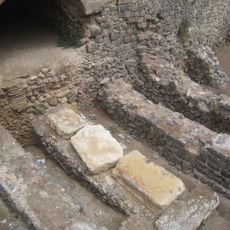
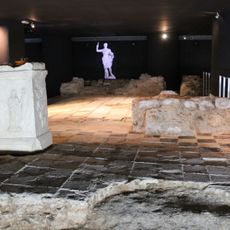
The House of Fortune is a Roman domus of the 1st century BCE entered from the Plaza de Risueño in Cartagena's old town. Its rooms include an atrium with mosaics, three cubicula, a triclinium whose walls were frescoed and whose ceiling carried peacock feathers, and a tablinum holding a small altar. Roman roads found beside the house are also visible.
The domus was built in the 1st century BCE. It was discovered and first excavated in 1970 by the archaeologist Pedro San Martín Moro during construction work for housing and a bank office; the bank, seeing the site's potential, financed the excavation. At first only the Roman roads, the entrance and two rooms could be visited. The full opening as a museum came later with the association Cartagena Puerto de Culturas, through a project by the architect Andrés Cánovas Alcaraz.
The pottery and household items scattered throughout the rooms tell the story of daily Roman life and family routines. These objects show how people spent their time and organized their homes.
Access is provided through guided tours offered in multiple languages, making the site easy to navigate. A single ticket typically grants entry to this location and other Roman ruins throughout the city.
The house takes its name from a Latin inscription reading "Fortuna propitia" (good fortune) placed at the rear entrance so that all who entered would be lucky. The site also preserves Roman roads discovered at the same time as the domus.
The community of curious travelers
AroundUs brings together thousands of curated places, local tips, and hidden gems, enriched daily by 94,043 contributors worldwide.