Barasona reservoir, reservoir in Spain
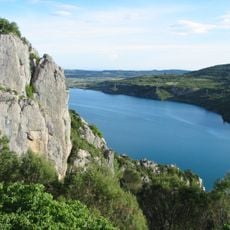
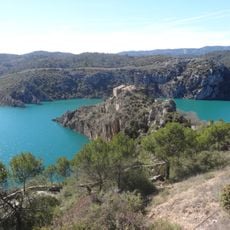
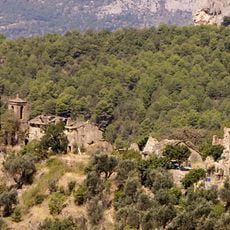
The Barasona reservoir is a large body of water in Huesca province, Spain, situated in a wide valley surrounded by mountains. The water spans a broad surface area, with shorelines that shift seasonally between flooded and exposed sandy or grassy banks depending on rainfall and water levels.
The reservoir was built between 1929 and 1932 as the head reservoir for the Canal de Aragón y Cataluña, inaugurated in 1906 without a storage dam. The 1911 irrigation law and the 1926 creation of river confederations provided the legal framework. Expropriations caused disputes into the 1960s, and during the Spanish Civil War the Republican army blew up the dam's gates to slow the Nationalist advance.
The reservoir takes its name from Barasona, a hamlet submerged when the dam was built, and its alternative name honours Joaquín Costa, promoter of the Canal de Aragón y Cataluña. Around its shores there is a campsite and establishments for rowing and fishing, so the water is used for sport as well as irrigation.
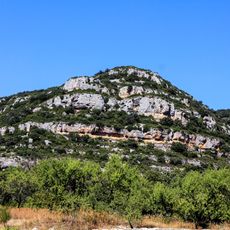
The dam closes the gorge opened in the Sierra de la Corrodella, and the reservoir's tail reaches the town of Graus, at the confluence of the Ésera and Isábena rivers. The Olvena gorge lies to the south. A campsite and establishments for rowing and fishing are found near the water.
The dam closes the gorge opened in the Sierra de la Corrodella, and the reservoir's tail reaches the town of Graus, at the confluence of the Ésera and Isábena rivers. The flooded village of Barasona gave the reservoir its alternative name; the dam rises 65 m and the water covers 69 ha with a volume of 92 hm³.
The community of curious travelers
AroundUs brings together thousands of curated places, local tips, and hidden gems, enriched daily by 94,081 contributors worldwide.