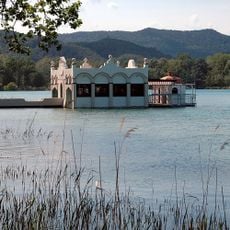
Fishing Huts, Heritage fishing structures at Lake Banyoles, Spain.
The Fishing Huts are twenty small, house-like structures built on the east and south shores of Lake Banyoles, on the town side. Each sits on wooden piles driven into the lake bed over the travertine slab, reached by a footbridge from the bank and closed by a grilled gate. Most are single-storey, rectangular and one-room, with a landing stage; their ornament ranges from late Neoclassical to Eclectic and Neo-medieval.
The huts were built between the late 1800s and early 1900s by local wealthy families seeking places to spend time by the water. The lake was a popular destination for leisure and fishing activities during this period.
The name pesquera comes from fishing: the first huts stored tackle and were reached by a plank or footbridge. From the mid-19th century the local bourgeoisie used them for leisure, boating and bathing, and some were enlarged to shelter one or two boats, with a ladder down to the water.
The huts are best viewed while walking around the lake on a seven kilometer path that circles the water. One of the huts operates as an information center where you can learn more about the structures and the lake.
The huts stand on the travertine slab beneath the lake, pushed out from the shore to reach water deep enough for fishing. Of the twenty surviving structures, five measure under fifteen square metres and only two exceed one hundred and sixty. Building new huts has been banned since 1931.
The community of curious travelers
AroundUs brings together thousands of curated places, local tips, and hidden gems, enriched daily by 93,597 contributors worldwide.