Church of San Nicolás, Romanesque church in Ávila, Spain
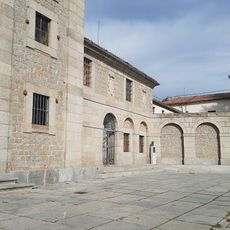
The Church of San Nicolás is a Romanesque church outside Ávila's walls, built of local berroqueña granite. It has three portals: the north and south are round-arched with simple archivolts and columns with rough capitals, while the west portal is pointed and decorated with star-shaped flowers. Inside, three naves are covered by plaster vaults from a Baroque reform; the square tower has no belfry, and the small apse is decorated only with simple corbels.
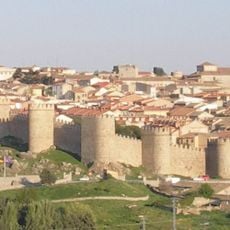
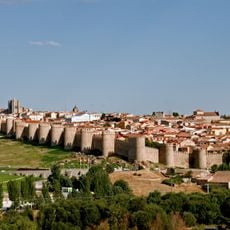
The structure was built during the medieval period as part of Ávila's religious infrastructure when the city was surrounded by fortification walls. It now forms part of the UNESCO World Heritage designation of Ávila's old town and its churches beyond the city walls.
San Nicolás is one of the extramural parishes of Ávila, churches built outside the city walls, and since 1985 it has formed part of the UNESCO World Heritage listing "Old Town of Ávila and its extramural churches" (ref. 348-006). The star-shaped flower motifs carved on its pointed west portal are a recurring ornament of Ávila's Romanesque, so the doorway is worth a close look.
San Nicolás stands outside the walled old town, among Ávila's extramural parishes, so it is reached on foot from the city walls rather than inside them. Its three doorways face north, south and west; the pointed western one with star-shaped flowers is the easiest to examine from the street. The interior is entered through these portals, and the square tower without a belfry is visible from the surrounding lanes.
The church is listed in the UNESCO World Heritage site "Old Town of Ávila with its Extra-Muros Churches" under reference 348-006, with a protected area of 0.05 hectares. It was declared a historical-artistic monument on 22 February 1980, and a protection zone linked to its status as a Bien de Interés Cultural followed on 1 August 1991.
The community of curious travelers
AroundUs brings together thousands of curated places, local tips, and hidden gems, enriched daily by 93,463 contributors worldwide.