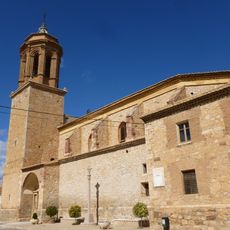
Fuente de Cella, Artesian well and spring in Cella, Spain.
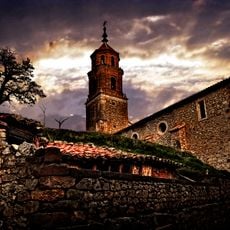
The Fuente de Cella is a large artesian well in Cella, Teruel, with an elliptical basin measuring 34.83 m by 24.84 m and a perimeter of 130 m, enclosed by a stone parapet. Its depth is 9 m at the edge and 11.5 m at the centre. Water exits at one end through a passage covered by a hermitage dedicated to Saint Clement.
The artesian well dates from the 12th century. Between 1729 and 1731, Captain of Engineers Domingo Ferrari ornamented it by order of the Audiencia de Aragón. On 14 March 1685, ownership of the spring and its waters was granted to José Esmir, Justicia Mayor de Aragón. It was listed as a Bien de Interés Cultural on 31 August 1983.
The spring functions as the source of the Jiloca River and supplies water through three main irrigation ditches to seven different municipalities in the region.
The basin is ringed by a stone parapet of ashlar blocks, so the water is viewed from the rim rather than approached directly. The outlet at one end runs beneath a small shrine dedicated to Saint Clement. The site lies within Cella itself, at the foot of the village, and the surrounding ditches still carry water toward the fields.
The basin's average outflow is about 3,500 litres per second, making it one of the largest and deepest artesian wells in Europe. Its water is shared out under the Reales Ordenanzas y Providencias of 1772, rules that still govern irrigation for Cella, Villarquemado, Santa Eulalia del Campo, Torremocha, Torrelacárcel, Alba and Villafranca del Campo.
The community of curious travelers
AroundUs brings together thousands of curated places, local tips, and hidden gems, enriched daily by 94,714 contributors worldwide.