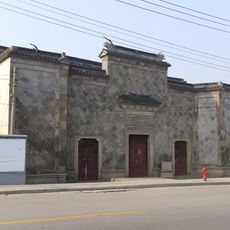
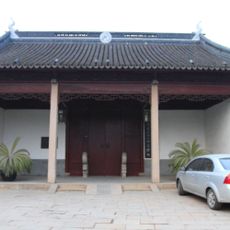
Tieling Gate, Ancient defensive gate in Jiangsu, China.
Tieling Gate is a Ming defensive gate on the Grand Canal beside Fengqiao in Suzhou. Its brick and stone platform, 15 m wide, 10.2 m deep and 7 m high, has a central arch inscribed "Tieling Guan" and a long staircase rising through the tunnel. A single-eave, three-room pavilion with a dark tiled roof stands on top, with red lanterns and flags on the facade.
Tieling Gate was built in 1557, the 36th year of the Ming Jiajing reign, as the Fengqiao enemy tower, one of Suzhou's three passes alongside the now-lost Hushu and Jinchang gates; it guarded the Fengqiao crossing of the Grand Canal against Japanese raiders. It was rebuilt in 1829, when its upper storey became the Wenxing Pavilion, and later fell into ruin. On 27 April 1949 the PLA's 29th Army broke through here to enter Suzhou. Repaired from 1986 to 1987, it is a Jiangsu provincial cultural relic.
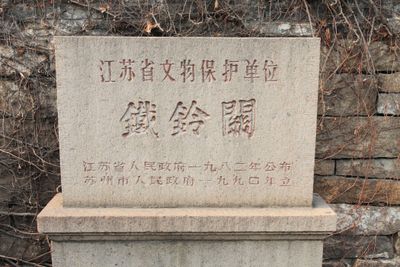
The gate is also called Fengqiao Enemy Tower, a name tied to its role in the Ming fight against Japanese raiders. Its arch once bore the inscription "Tieling Gate"; the present three-room single-eave pavilion on the platform dates from the 1986–1987 restoration. The stone marker records its 1982 listing as a Jiangsu provincial cultural relic.
The gate stands beside the Fengqiao bridge and the Grand Canal, next to Hanshan Temple in Suzhou's western suburbs. The archway holds a brick staircase up to the platform, so expect steps and a dark passage. The marker stone at the arch base records the 1982 provincial listing and the 1990 Suzhou municipal erection.
The gate is one of Suzhou's "Three Passes"; the other two, Hushu Pass and Jinchang Pass, no longer survive. Inside the arch, brick steps climb to the platform and a garrison chamber is built into the structure. The stone marker records its 1982 listing as a Jiangsu provincial cultural relic.
The community of curious travelers
AroundUs brings together thousands of curated places, local tips, and hidden gems, enriched daily by 93,117 contributors worldwide.