Arch of Dativius Victor, Roman triumphal arch in Mainz, Germany
The Arch of Dativius Victor is a Roman triumphal arch in Mainz that stands roughly 6.5 meters (21 feet) tall and 4.5 meters (15 feet) wide, featuring detailed stone carvings with vine reliefs and zodiac symbols. The construction displays craftsmanship visible in both its surviving forms.
The arch was built in the mid-3rd century as the central passage of a portico belonging to a public building in Mogontiacum. The donor inscription records that the sons of the deceased decurion Dativius Victor erected it in his legacy, honouring the imperial house and Jupiter. After the Roman period, its blocks were reused in the medieval city wall on the Kästrich, from which they were recovered between 1898 and 1911.
The keystone shows Jupiter with a sceptre and thunderbolt, his foot on a globe, beside Juno holding a torch. Above the arch, a toga-clad priest—likely Dativius Victor himself, a decurio and imperial-cult priest—is shown sacrificing, flanked by two season genii. The vine reliefs and zodiac on the archivolt copy motifs also found on sarcophagi and Mithras reliefs of the period.
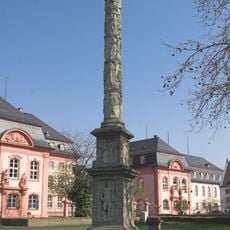
The original work stands in the stone hall of the Landesmuseum Mainz, while a full-scale replica has been on display at Ernst-Ludwig-Platz since 1962. Visitors can explore both versions to understand the Roman architecture and how it was transformed across the centuries.
Workers discovered the original architectural elements between 1898 and 1911, where they had been built into the medieval city wall and reused as construction material. This reuse shows how Roman materials were preserved and adapted across many generations.
The community of curious travelers
AroundUs brings together thousands of curated places, local tips, and hidden gems, enriched daily by 94,663 contributors worldwide.