Beeckerwerth Bridge, Cable-stayed road bridge in Duisburg, Germany
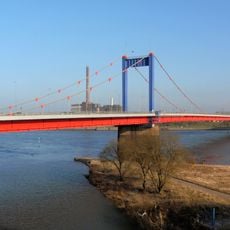
The Beeckerwerth Bridge is a 1,030 m long cable-stayed bridge over the Rhine between Duisburg-Beeckerwerth and Baerl. Its two steel pylons, 66.7 m high, stand in the bridge axis and carry three harp-shaped groups of cables on each side. The river span is 310 m, and the deck is 40.95 m wide with three lanes per direction plus a cycle and foot path on the downstream side.
Planning approval for the A42 route came in June 1980, confirmed by the Münster higher administrative court in late 1985 and legally binding in late June 1986. Construction ran from July 1986 to October 1990 at a cost of 134 million DM, carried out by Hochtief AG with steelwork from HRA Bochum.
The bridge carries the A42, the Emscherschnellweg, and around 67,000 vehicles crossed it daily in 2005. Its steel pylons and 12 cables were made by HRA Bochum, while Hochtief AG built the structure between 1986 and 1990. The name comes from Beeckerwerth, the Duisburg district on the left bank; the opposite end lies in Baerl.
The bridge is part of the Bundesautobahn 42 and is crossed daily by many vehicles, so delays can occur during rush hour. It is advisable to allow more time for crossing during commuting hours.
The bridge stands in a mining area: to protect it from mining subsidence, its piers were placed on ground left free by the mining company for the neighbouring Haus-Knipp Bridge. Its two steel pylons rise in the bridge's central axis, widening from 2.85 m to 5.05 m towards the top for architectural reasons.
The community of curious travelers
AroundUs brings together thousands of curated places, local tips, and hidden gems, enriched daily by 94,167 contributors worldwide.