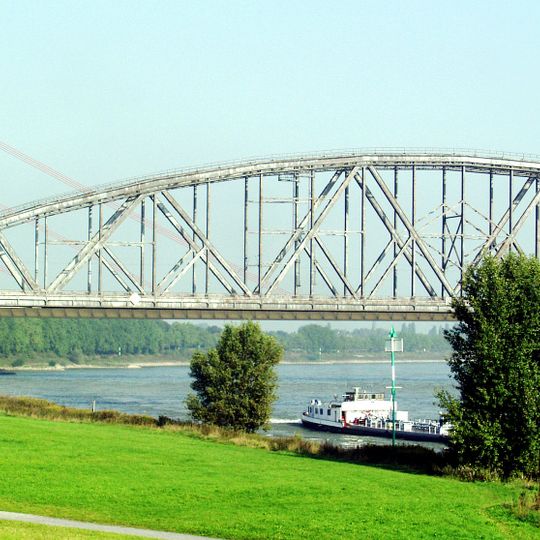
Haus-Knipp railway bridge, Railway truss bridge in Duisburg, Germany.
The Haus-Knipp railway bridge carries the Oberhausen–Moers line over the Rhine between Duisburg-Beeckerwerth and Duisburg-Baerl. Its main river opening is a 186-metre truss span, flanked by two 106-metre truss bridges; the floodplain is crossed by three spans on the left bank and nine on the right. In total 24 truss sections, each 41 metres long, rest on piers, and the bridge has no pylons.
Construction began in March 1910, and the bridge opened for freight traffic on 1 October 1912; passenger trains followed on 15 May 1929. Retreating German troops blew it up on 5 March 1945, and the 9th US Army took the site in the following days. British engineers rebuilt the only lightly damaged bridge in its original truss form during 1945, and it reopened on 26 February 1946.
The bridge takes its name from Haus Knipp, a medieval manor that stood below today's crossing on the Beeckerwerth side; the Rhine then flowed further east and destroyed it in 1571. A new Haus Knipp was built about 1 km upstream in 1620 and demolished in 1939 when the Rhine dike was raised. For Rhine shipping the bridge has long served as a landmark.
The bridge was restored in 2012 to support two railway tracks, allowing both freight and passenger trains to use it simultaneously. Access to the bridge itself is typically not available to visitors since it remains an active railway line.
The bridge's name comes from Haus Knipp, a medieval manor that stood directly beneath today's crossing on the Beeckerwerth side; the Rhine then flowed further east and shifted west over the years. The river destroyed that house in 1571, a replacement was built about 1 km upstream in 1620, and the decayed building was demolished in 1939 during raising of the Rhine dike.
The community of curious travelers
AroundUs brings together thousands of curated places, local tips, and hidden gems, enriched daily by 92,700 contributors worldwide.