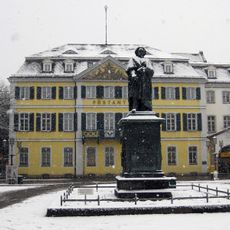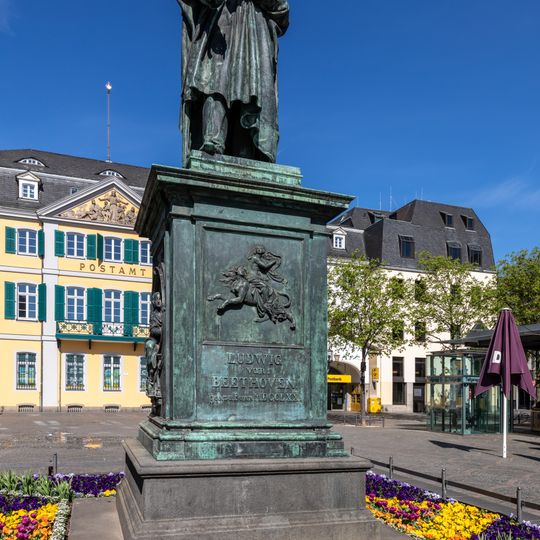
Beethoven Monument, Bronze statue in Münsterplatz, Bonn, Germany.
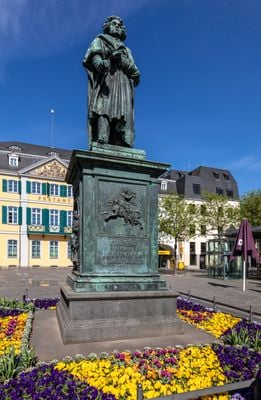
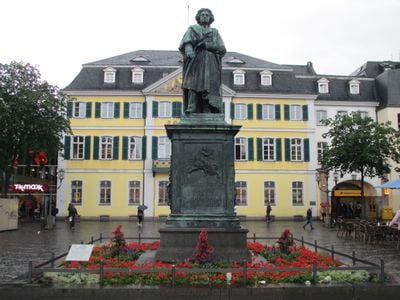
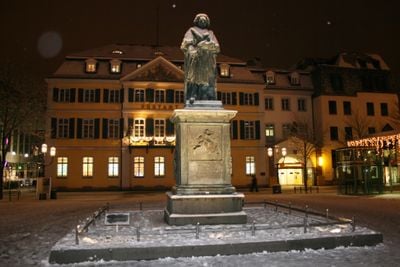
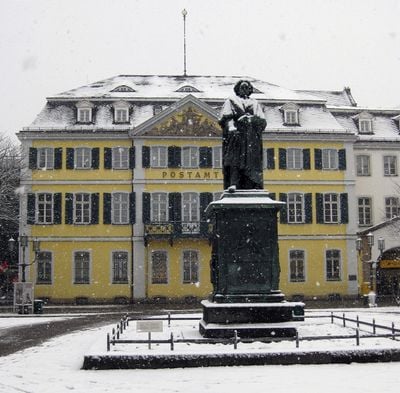
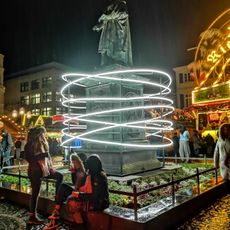
The Beethoven Monument is a dark bronze standing figure in long draped robes atop a tall stone pedestal. The pedestal is rectangular, faced with green-patinated bronze panels, and rests on a broad grey stone base. The front panel carries a relief of a winged figure above a reclining animal, with the inscription "LUDWIG VAN BEETHOVEN" below. It stands on the paved Münsterplatz, with a yellow and a white building behind.
Heinrich Carl Breidenstein first proposed a Beethoven monument in Bonn in 1828. The Bonn Association for the Beethoven Monument, led by August Wilhelm Schlegel, issued an international appeal in 1835. Franz Liszt donated over 10,000 francs and returned to the concert stage to fund the project. The monument, designed by Ernst Hähnel and cast by Jakob Daniel Burgschmiet, was unveiled on 12 August 1845 during the first Beethovenfest.
The monument's pedestal carries allegorical reliefs by Ernst Hähnel: the front shows a Greek sphinx with a woman's head and lion's body raised by a muse playing the lyre, standing for Fantasy. The left panel depicts Saint Cecilia for sacred music, the right a masked female figure for dramatic music, recalling Egmont, Coriolan and Fidelio.
The monument stands freely accessible on Münsterplatz and is easy to find since the square is in the heart of Bonn. A visit is possible at any time of day, and the location is reachable for people with varying mobility needs.
The sealed lead capsule walled into the pedestal holds the inauguration charter signed by Queen Victoria and Prince Albert, not a parchment of signatures. Two days before the unveiling, on 10 July 1845, printed copies of the Missa solemnis and the Ninth Symphony from Schott of Mainz were also placed inside the pedestal.
The community of curious travelers
AroundUs brings together thousands of curated places, local tips, and hidden gems, enriched daily by 93,671 contributors worldwide.