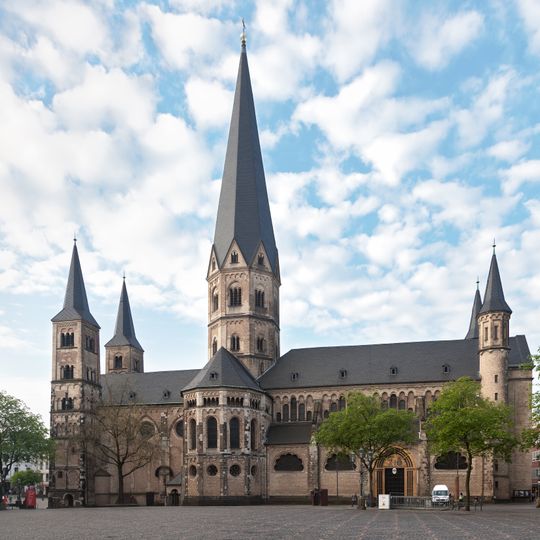
Bonn Minster, Romanesque cathedral in Bonn, Germany
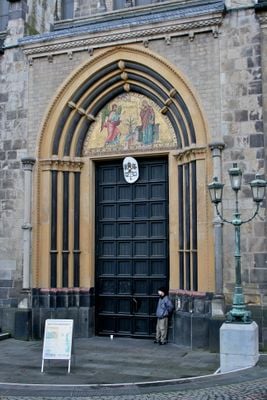
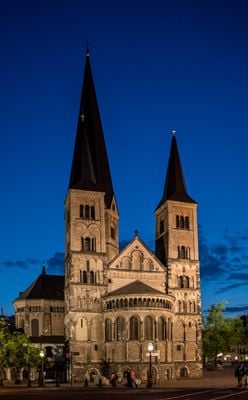
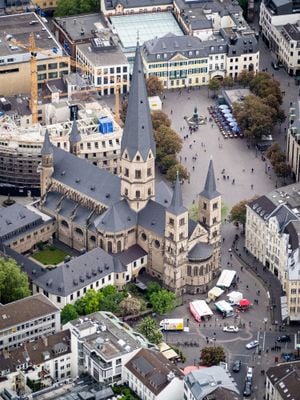
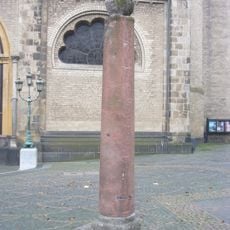
This church is a Romanesque basilica with five towers in central Bonn, its tallest spire reaching about 87 meters above the ground. The building shows heavy stone walls, rounded arches, and small windows that allow soft light into the interior.
A memorial chapel was built in the early 4th century in a suburban cemetery about 1 km south of the Roman fortress, on the site where Saints Cassius and Florentius are said to have been beheaded. A memorial building replaced it in the 6th century, and in the 8th century the Collegiate Church of SS. Cassius and Florentius arose. The old collegiate church was demolished around 1050 for a Romanesque three-aisled basilica, one of the first large church complexes in the Rhineland; from 1140 to 1250 it was rebuilt in late Romanesque style.
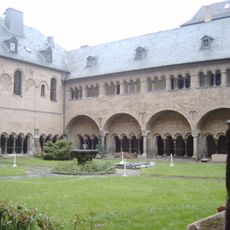
The minster is dedicated to Saints Cassius and Florentius, two Theban Legion soldiers believed beheaded on this spot; their relics were placed in precious shrines on the high altar by Provost Gerhard von Are in 1166. The crypt's bronze trapdoor opens only during the octave of the city patrons' festival, when four black marble slabs donated by a canon in 1701 cover the legendary graves. The south cloister, built under Gerhard von Are, is considered the most completely preserved Romanesque cloister north of the Alps.
The church sits on Gangolfstraße 14 in central Bonn and can be reached on foot from many points in the city center. Visitors should keep in mind that access for tourists may be limited during religious services.
In the north transept, a medieval organ from 1230 sits on the east wall and ranks among the oldest in Germany. The mechanism and pipes have been renewed several times over the centuries, but the historic location and parts of the construction remain in place today.
The community of curious travelers
AroundUs brings together thousands of curated places, local tips, and hidden gems, enriched daily by 92,806 contributors worldwide.