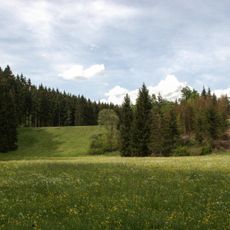
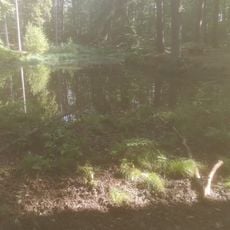
Brunnenmühlenquelle, Karst spring in Heidenheim an der Brenz, Germany.
The Brunnenmühlenquelle is a karst spring between Heidenheim an der Brenz and Mergelstetten, at the foot of the right bank of the Brenz. Its spring pool is publicly accessible, and the Goldquelle lies on the opposite side of the valley, slightly downstream. The spring discharges an average of about 1,500 litres per second, ranging from 500 to 5,000 litres per second.
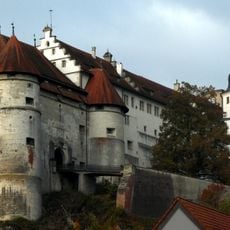
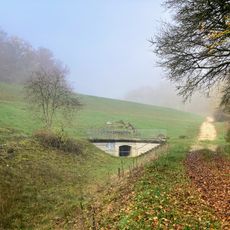
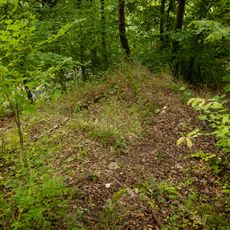
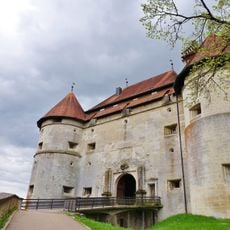
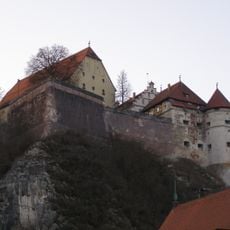
Around 1585, spring water was raised to Hellenstein Castle through a wooden channel. A waterwheel drove a piston that pumped water about 100 metres up to a reservoir on the Schwende; its remains are still visible. From there the water ran down roughly 13 metres into the castle, while another part fed four pipe fountains in Heidenheim's old town. Duke Friedrich I had the waterwheel demolished, and the system was renewed in 1604 with lead pipes instead of wood. It was destroyed in the Thirty Years' War, and when the town drilled eight wells into the groundwater in 1666 the spring lost its role in Heidenheim's water supply.
The spring has long been central to local water supply and shapes how people in the region relate to their landscape. Visitors can observe how natural water sources influenced where communities settled and grew.
The location is easy to reach, situated directly between Heidenheim and Mergelstetten along the Brenz, accessible from the riverbank path. Visitors should know that water volume changes significantly with rainfall and snowmelt, and access can become difficult during high water periods.
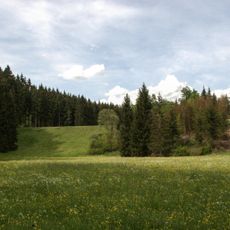
The spring's underground catchment covers over 100 km², reaching about 16 km west of Heidenheim to the Alb plateau near Böhmenkirch and taking in the Stubental valley. Its average flow of roughly 1,500 litres per second makes it the third-strongest spring on the Swabian Alb.
The community of curious travelers
AroundUs brings together thousands of curated places, local tips, and hidden gems, enriched daily by 93,957 contributors worldwide.