Brühl, Park in Quedlinburg, Germany
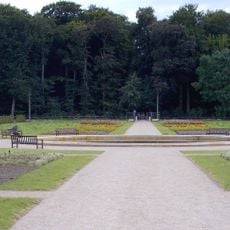
Brühl is a roughly 15-hectare park south of the Schlossberg in Quedlinburg, laid out as a garden square with four linden-lined main avenues meeting at a central rondell, crossed by two diagonal avenues added later. In 1866 it was redesigned as an English-style landscape park with oaks, beeches and rare trees such as tulip tree, cut-leaved lime, pyramidal oak and plane.
Brühl was first documented in 1179 as property of St. Wiperti monastery; the name then denoted a marshy meadow. After the Reformation it passed to the Damenstift, and from the mid-17th century townspeople used it as a Lusthölzchen. In 1685 Abbess Anna Dorothea had four lime-planted main avenues laid out around a central rondell; the two diagonal avenues followed in 1757 under Anna Amalia. In 1818 Friedrich Wilhelm III gave the park to the city, and in 1866 Eduard Petzold redesigned it as an English-style landscape park.
The name Brühl comes from a marshy meadow owned by St. Wiperti monastery, mentioned in 1179. From the mid-17th century Quedlinburgers used the grounds as a Lusthölzchen, a pleasure grove. Since 2001 the park has been reworked along historical models and joined the Gartenträume network of 50 historic parks in Saxony-Anhalt.
The site is conveniently walkable and well-integrated into the old town's pathways, allowing visitors to explore multiple monuments in a single day. Shaded spots beneath trees offer pleasant resting places, especially on warmer days, and the level terrain makes strolling comfortable for visitors of various mobility levels.
The Brühl is a water protection zone whose wells supply Quedlinburg's drinking water. Since the old waterworks closed in the 1990s, water flowed untreated to the Hochspeicher Altenburg; in 2019 a new plant beside the park began softening water from eight wells by reverse osmosis, lowering hardness from 22 °dH to 5 °dH.
The community of curious travelers
AroundUs brings together thousands of curated places, local tips, and hidden gems, enriched daily by 93,793 contributors worldwide.