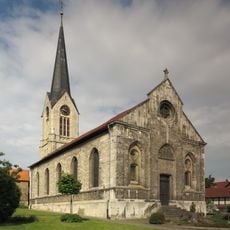
Burg Warburg, Medieval castle in Schöningen, Germany.
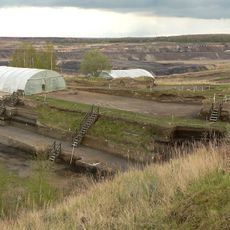
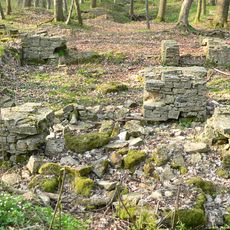
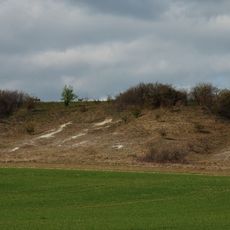
Burg Warburg is a motte-and-bailey castle site on the eastern slope of the Elm ridge, about two kilometres southwest of Warberg. Its U-shaped double rampart and ditch enclose a round plateau roughly 42–46 metres across, ringed by a 5.5-metre-deep pointed ditch. Excavations found the 13 × 13-metre cellar of a residential tower with three-metre-thick foundations.
Built around 1100 as a motte of the von Hagen family, the castle was stormed and destroyed in 1200 by Archbishop Ludolf of Magdeburg during the throne dispute between the Staufers and the Welfs. No rebuilding followed; the lords moved to the plain and founded the Wasserburg Warberg about two kilometres northeast in the early 13th century. Excavations by Hans Adolf Schultz from 1962 to 1965 confirmed the violent end.
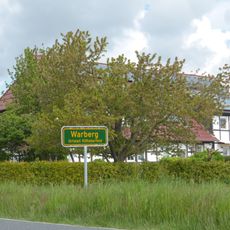
The name Warburg survives in the forest path signposted from the Warberg–Räbke road, and the site is reached on foot about 50 m west of the track. Excavations in 1962–1965 under Hans Adolf Schultz recovered arrowheads, spurs, horseshoes and knives from a 20 cm debris layer, plus a carved bone plaque 8.5 cm high showing three towers, now read as a stylised town view.
The site is walkable from Schöningen town center with marked paths and informational signs along the way describing the ruins and discoveries. The terrain is uneven with exposed stone foundations, so sturdy footwear and care when walking are recommended.
The most notable find from the 1962–1965 excavations is an 8.5 cm carved bone plaque showing three towers, first interpreted as a medieval residential tower and now as a stylised town view. A 3.5 cm bone mount with a winged dog was also uncovered. The castle's cellars lay 3.8 m deep because its stone was later removed for building material.
The community of curious travelers
AroundUs brings together thousands of curated places, local tips, and hidden gems, enriched daily by 93,246 contributors worldwide.