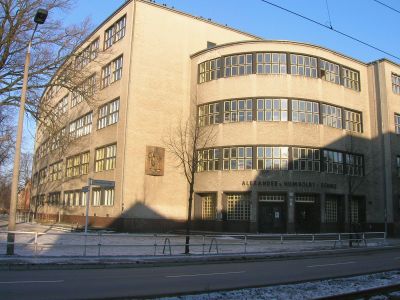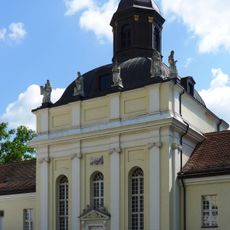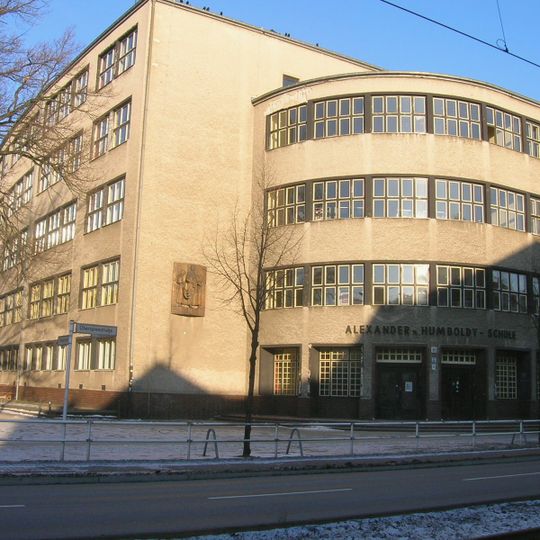
Alexander-von-Humboldt-Oberschule, Bauhaus school building in Köpenick, Berlin, Germany
The Alexander-von-Humboldt-Oberschule is a school building with a wing-shaped layout, covered in unglazed yellow ceramic tiles and built with steel-reinforced concrete. The structure features five classroom wings arranged in a distinctive angular pattern.
The building was constructed in 1929 by architect Max Taut, embodying Bauhaus principles in its design. It served as housing for athletes during the 1936 Olympics and later as emergency shelter after World War II.
A ceramic relief by Rudolf Belling at the main entrance shows Saint Dorothy giving bread to refugees, linking education with helping those in need. This artwork shapes how visitors perceive the school's public face today.
The school is located near Spindlersfeld S-Bahn station in Köpenick, making it easy to reach by public transport. The main facade and entrance are visible from outside and accessible to visitors without needing to enter the school grounds.
The building was repurposed as temporary housing for athletes during the 1936 Olympics before becoming an emergency hospital right after World War II. This dual unexpected role reveals how closely the site was tied to the major political events of the 20th century.
The community of curious travelers
AroundUs brings together thousands of curated places, local tips, and hidden gems, enriched daily by 91,116 contributors worldwide.