Tajogaite volcano, Recent volcano in Cumbre Vieja, La Palma, Spain.
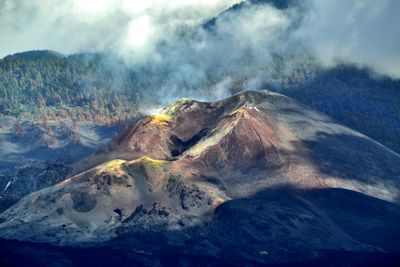
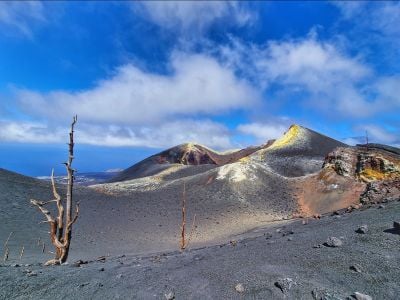
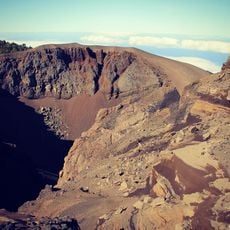
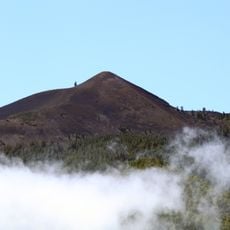
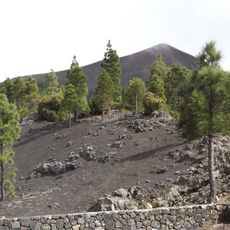
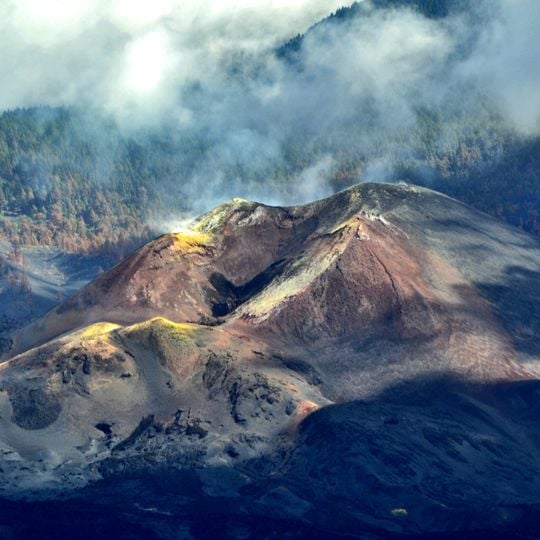
Tajogaite is a monogenetic cinder cone of the Cumbre Vieja ridge in El Paso, La Palma, built from loose ash and scoria in dark brown, grey and rust-red tones. Its summit reaches 1,120 metres above sea level, with the cone rising about 200 metres above the pre-eruptive ground. The main crater measures 172 by 106 metres and is one of seven vents; a deep notch cuts its rim, and yellowish-green deposits streak the upper slopes above gullied flanks.
The Tajogaite eruption began on 19 September 2021 and ended on 13 December 2021 after 85 days, making it the longest historical eruption recorded on La Palma and the third in the Canary Islands. It ejected over 200 million cubic metres of lava, destroyed 2,988 buildings, mostly homes, and buried 73.8 kilometres of roads, cutting all land routes in the west of the island. About 7,000 people were evacuated; around 1,000 began returning on 3 January 2022 where their homes had survived.
Tajogaite is the name of an area in El Paso municipality, south of Los Romanciaderos and near Montaña Rajada. The toponym appears in local land-ownership records from the 18th century, but its use goes back to the time of the Benahoarites, the island's pre-Hispanic inhabitants. The volcano took this place name when it was officially named.
Visitors can reach the site through guided walks starting at Llano de Los Jables at 1200 meters elevation. The circular trail covers roughly 5 kilometers and requires sturdy footwear and plenty of water.
The lava flows extended the island's coastline and formed 47 hectares of new land when they reached the sea. This land formation changed the shape of the island permanently and created fresh rock formations along the western shore.
The community of curious travelers
AroundUs brings together thousands of curated places, local tips, and hidden gems, enriched daily by 94,781 contributors worldwide.