Cueva de Las Palomas, Natural monument and lava tube in La Palma, Spain
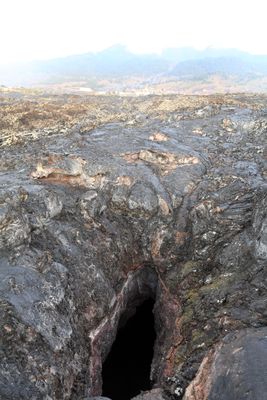
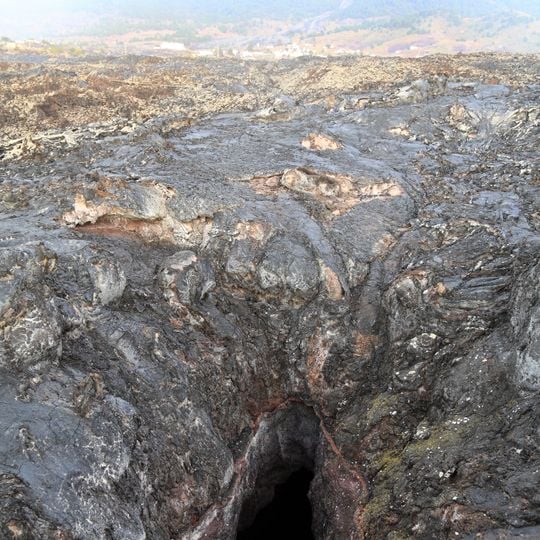
Cueva de Las Palomas is a lava tube formed during the 1949 San Juan eruption, when lava from the Llano del Banco vent drained and left a gallery about 3 metres wide and 560 metres long. It has more than ten openings, some of them old degassing vents, and its walls reach 3 to 4 metres high, with wide halls and narrow passages.
The tube formed during the 1949 San Juan eruption, from the lava flow that surfaced at Llano del Banco and ran west; the draining lava left the gallery open. It was declared a paraje natural de interés nacional by Law 12/1987 and reclassified by Law 12/1994. Law 9/2014 changed its name to Monumento Natural del Tubo Volcánico de Cueva de Las Palomas.
The name Las Palomas (doves) comes from the pigeons and doves that use the tube as a roost and nest site; their droppings and the shells of the land snail Hemicycla accumulate inside. The entrance depression is called a jameo, a word from the Guanche language meaning a hollow or dip in the ground. The tube was long officially named Tubo Volcánico de Todoque, after the nearby village, until the 2014 law changed the designation.
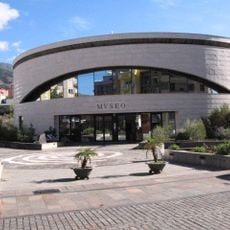
The main entrance of Todoque I is a large collapse hollow, called a jameo, beside the LP-211 road between Todoque and Las Manchas. The tube has three- to four-metre walls, wide halls, narrow passages and steep descents. In the lava field, the Centro de Interpretación de las Cavidades Volcánicas Caños de Fuego opened in April 2019; its basement gives step-free access to a 15-metre section of the El Vidrio tube.
The cave's entrance is a large collapse hollow called a jameo, a Guanche word for a hollow in the ground. The tube's ceiling also holds small stalactites, probably gypsum or calcite, crystallised from rainwater that dissolved minerals while seeping through the lava.
The community of curious travelers
AroundUs brings together thousands of curated places, local tips, and hidden gems, enriched daily by 94,044 contributors worldwide.