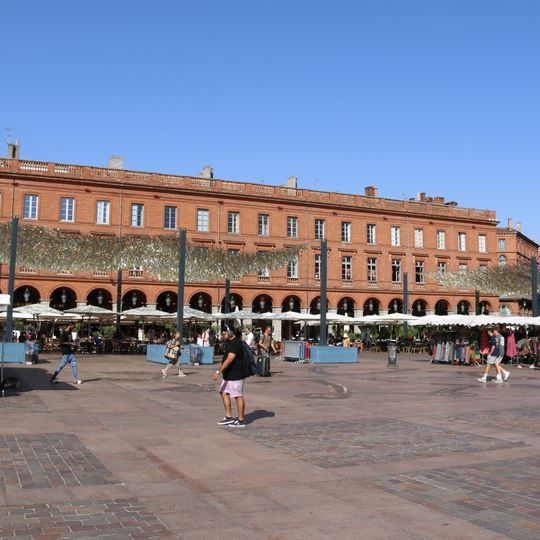
Place du Capitole, Central square in Toulouse, France
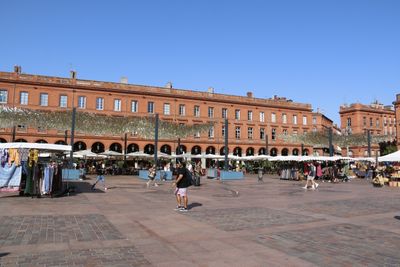
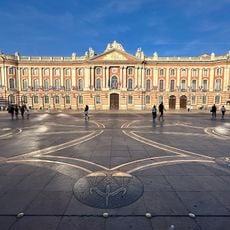
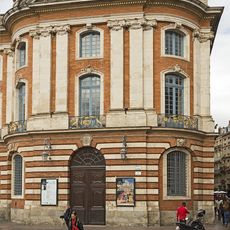
The Place du Capitole is a rectangular square 126 metres long and 92 metres wide, paved with pink granite. Its east side is the monumental brick facade of the Capitole, housing the city hall and the Théâtre du Capitole; the south, north and west sides are neo-classical facades built between 1809 and 1852, the west one with arcades modelled on the Rue de Rivoli. A large Occitan cross by Raymond Moretti is set into the paving.
The square was planned from 1676, when the capitouls decided to create a Place Royale and won the parliament's approval by promising a statue of Louis XIV. Antoine Rivalz drew the plan in 1730; work began in 1750 and ended in 1792. The south, north and west sides were built in neoclassical style between 1809 and 1852 to designs by Jacques-Pascal Virebent, the west side completed by Jean Bonnal.
The arcades carry 29 colourful paintings by Raymond Moretti, finished in 1997, recalling episodes of Toulouse's history. The square's name comes from the Capitole, the capitouls' common house since the 16th century. Cafés such as Bibent, whose interior is listed since 1978, keep their brass signs to match the brick.
The square is best visited in the morning when vendors display regional products, clothing, and vintage items for sale. The area is walkable and offers plenty of space for strolling and exploration.
The Occitan cross set into the paving was made by Raymond Moretti in 1995; its arms carry the twelve signs of the zodiac, the twelve months and the twelve hours of the day. Moretti also painted the twenty-nine panels under the arcades, finished in 1997, which show episodes from the city's history.
The community of curious travelers
AroundUs brings together thousands of curated places, local tips, and hidden gems, enriched daily by 94,755 contributors worldwide.