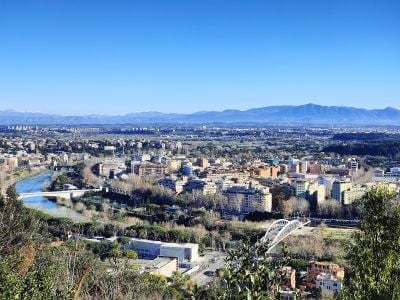
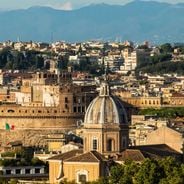
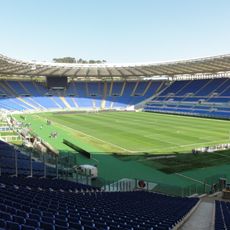
Monte Mario, Hill and nature reserve in northwestern Rome, Italy.
Monte Mario is a 139-metre hill in northwestern Rome, crossed by the Via Trionfale and topped by the church and convent of the Madonna del Rosario, the Villa Mellini complex with the Monte Mario Observatory and the Museo Astronomico Copernicano, and two lattice masts. Its eastern side is a 204-hectare nature reserve, while the western slope holds the Balduina and Trionfale districts.
In ancient times, the Romans used the hill as a strategic observation post overlooking the surrounding territories. Later, it became an important waypoint along the Via Francigena, the major medieval pilgrimage route leading to Rome.
The hill served as a landmark for pilgrims traveling to Rome throughout the centuries, welcoming visitors before they entered the city. This role shaped how locals and travelers viewed the landscape around them.
The hill is easily accessible and offers good conditions for exploring, with clear paths and regular signposting throughout the reserve. The best time to visit is early morning or late afternoon when visibility is clearest and the area is less crowded.
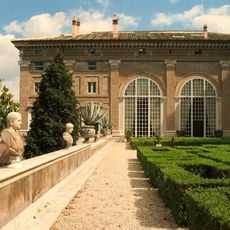
The Monte Mario Observatory stands on the site of the 15th-century Villa Mellini, which has housed the Museo Astronomico e Copernicano since 1935. The hill's meridian, at 12°27'8.4"E, served as the reference for Italian maps until the 1960s, and the site also gave rise to the Roma 40 datum used in the Gauss-Boaga projection.
The community of curious travelers
AroundUs brings together thousands of curated places, local tips, and hidden gems, enriched daily by 94,658 contributors worldwide.