H Palace, Historical building in Rome, Italy
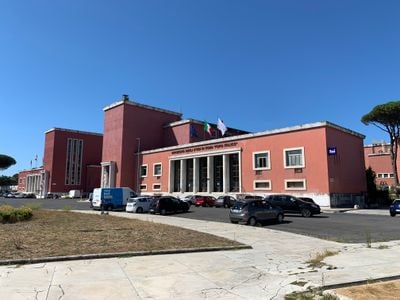
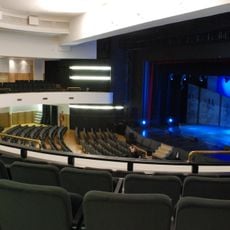
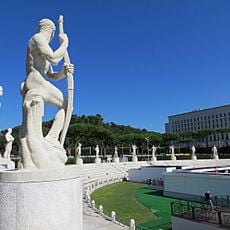
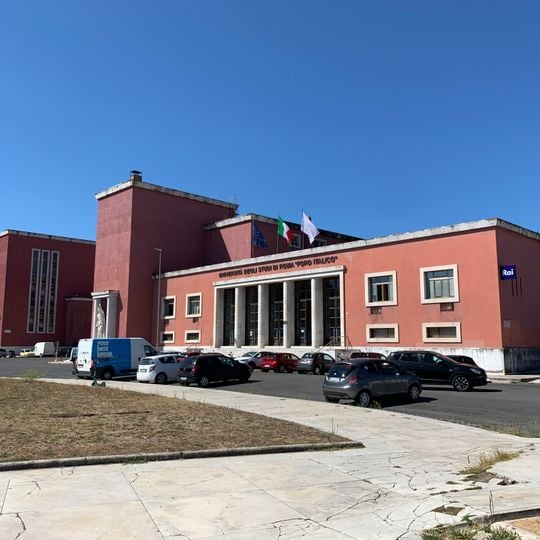
H Palace is a two-storey building in the Foro Italico whose two symmetrical wings are joined by a large ramp, giving it an H-shaped plan and its name. Six tall columns form a portico on the lower facade, and four athlete statues stand in marble niches with broken triangular pediments. A monumental semi-oval gymnasium with raised galleries adjoins it.
Designed by Enrico Del Debbio in 1927, Palazzo H was the first building of the Foro Italico (then Foro Mussolini). Benito Mussolini laid the first stone on 28 February 1928, and it opened in 1932 as the Fascist Male Academy of Physical Education. In March 1951 Giulio Onesti made it the CONI headquarters; restoration was planned in 2018, and since 2019 it has also housed Sport e Salute.
The name comes from the H-shaped plan formed by two symmetrical two-storey wings joined by a large ramp. In the hall of honour, Luigi Montanarini's 1928 mural Apoteosi del Fascismo stayed hidden behind a green cloth for decades and was uncovered only in 1997 on the order of the Soprintendenza; Angelo Canevari painted the allegory of ancient Rome, and Romano Dazzi four sporting subjects.
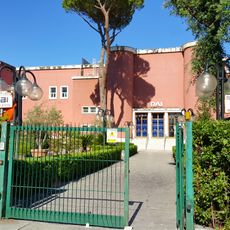
The building stands inside the Foro Italico complex on the Tiber's right bank, northwest of central Rome. The main facade with the portico and the "Università degli Studi di Roma Foro Italico" inscription faces a car park, so it is seen from outside; the CONI offices are not open for tours. The monumental gymnasium with raised galleries sits alongside.
In the hall of honour, Luigi Montanarini's 1928 mural "Apoteosi del Fascismo" was hidden behind a green cloth for decades after the war and uncovered only in 1997 on the order of the Soprintendenza. The atrium holds Emilio Greco's bronze "La Fiaccola Olimpica", made for the 1960 Rome Olympics and first placed in the Palazzo dello Sport at EUR.
The community of curious travelers
AroundUs brings together thousands of curated places, local tips, and hidden gems, enriched daily by 93,177 contributors worldwide.