Showa Bridge, Road bridge in Sakaki, Japan
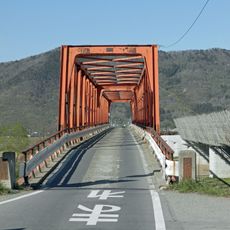
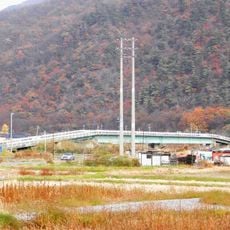
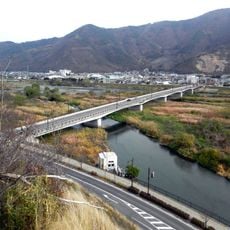
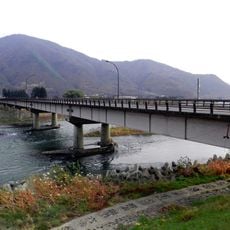
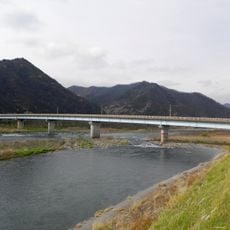
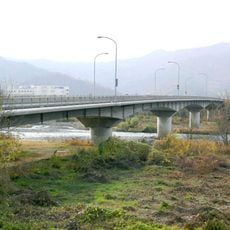
Showa Bridge is a road bridge crossing the Chikuma River that carries traffic between the banks using reinforced concrete and steel construction methods. The structure was designed to withstand strong river currents and seasonal flooding.
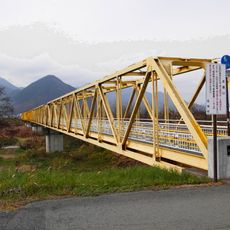
A wooden bridge opened here on 3 June 1928, funded with a 7,000-yen subsidy from Nagano Prefecture. In 1937 the right-bank section was rebuilt as a three-span reinforced-concrete rose girder designed by Takeshi Nakajima, while the left bank remained timber. The central six-span RC rose girder followed on 10 November 1952, and the steel cantilever span opened on 25 September 1964.
In 2002 the Japan Society of Civil Engineers listed Showa Bridge among five Nagano bridges as a Selected Civil Engineering Heritage site, citing the group of reinforced-concrete rose girders designed by Takeshi Nakajima. The bridge is a town road (Sakaki route 0621) and remains in use.
The roadway is narrow and requires slower vehicle speeds due to limited space on the bridge. During rainy seasons the river can rise quickly, so it is wise to check weather conditions before crossing.
The bridge's nine reinforced-concrete rose girders were designed by engineer Takeshi Nakajima, whose group of RC rose-girder bridges in Nagano Prefecture was certified as a JSCE Selected Civil Engineering Heritage in 2002. The steel cantilever section on the left bank opened on 25 September 1964, completing an all-permanent span.
The community of curious travelers
AroundUs brings together thousands of curated places, local tips, and hidden gems, enriched daily by 93,360 contributors worldwide.