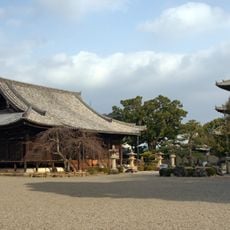
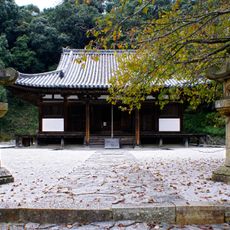
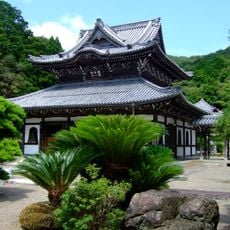
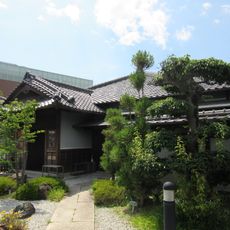
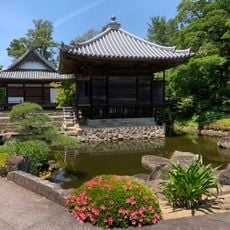
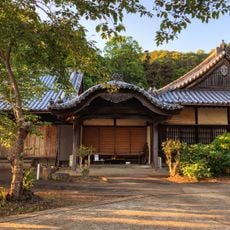
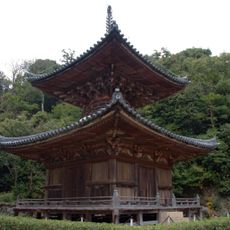
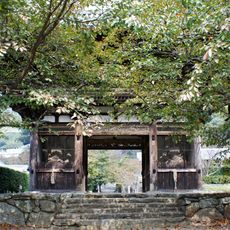
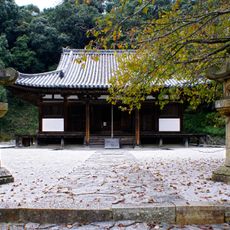
Hongan-ji Hidaka Betsuin, Jodo Shinshu Buddhist temple in Gobō, Japan.
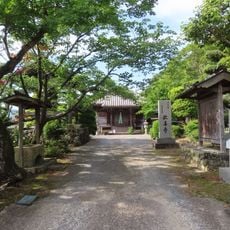
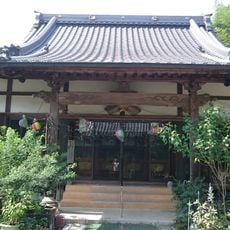
Hongan-ji Hidaka Betsuin is a Jodo Shinshu Buddhist temple in the city of Gobō, in Wakayama Prefecture on the Kii Peninsula. The compound is made up of several wooden buildings with curved, tiled roofs arranged around a central courtyard, following the layout typical of this branch of Buddhism.
In the Tenbun era (1532–1555), Yukawa Naomitsu, defeated in battle against the Miyoshi clan, built a hall at Yoshiwara-ura and installed his second son Nobuharu as its priest. The hall became the Yoshiwara Bōsha, burned in Toyotomi Hideyoshi's 1585 invasion of Kishū, and was rebuilt as a temporary hall at Tsubakihara in 1586. Moved to Shimamura in 1595, it became the Hidaka Bōsha; the present main hall was rebuilt in 1825, and the name Hongan-ji Hidaka Betsuin was granted in 1877.
The word "betsuin" refers to a branch temple directly affiliated with a head temple, in this case the Hongan-ji in Kyoto, which gives this site a formal standing within the Jodo Shinshu tradition. Visitors can see how local worshippers use the main hall for daily prayer and seasonal ceremonies.
The temple grounds are generally open during the day, and visitors are welcome to walk through the courtyard and look at the main hall from outside. Arriving early in the morning gives you a chance to observe the daily prayer routine without crowds.
The temple's ginkgo tree, a prefectural natural monument since 1958, is said to have been planted around 1595 when the temple buildings were moved to this site; its estimated age is about 400 years. The temple's name gave the city its name: the district grew up around the "Gobō" temple and became the commercial centre of the Hidaka area.
The community of curious travelers
AroundUs brings together thousands of curated places, local tips, and hidden gems, enriched daily by 94,610 contributors worldwide.