Akebono Köprüsü, Road overpass in Shinjuku, Tokyo, Japan
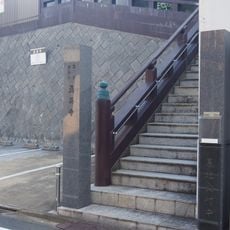
Akebono Bridge is a 103-metre road overpass on Gaien-Higashi-dori in Shinjuku, Tokyo, crossing Yasukuni-dori on the boundary between Katamachi and Arakicho. Its green steel girder deck rests on a concrete abutment, with a low railing and a row of small round lights along the fascia; four traffic lanes and two footways run across it.
The overpass was first proposed in the 1920s as part of Tokyo's reconstruction after the 1923 Great Kanto Earthquake, but funding shortfalls left the link unbuilt for decades. In 1954 the Shinjuku ward development council revived the plan, and construction began in 1955 under the provisional name Kappazaka Overpass. A public competition chose the name Akebono in June 1956, and the bridge opened on 4 June 1957 with a parade.
The name Akebono, meaning dawn, was chosen in a public competition on 21 June 1956 to express hope for recovery and growth after the war. The bridge gave its name to the Toei Shinjuku Line station opened directly beneath it on 16 March 1980, and today Akebono-bashi also serves as the name of the surrounding district.
The bridge carries four traffic lanes of Tokyo Route 319 (Gaien-Higashi-dori) over Yasukuni-dori, with sidewalks on both sides for pedestrians. Akebono Station on the Toei Shinjuku Line lies almost directly beneath it, and the bridge links the former Yotsuya and Ushigome districts, now part of Shinjuku.
The bridge was first called Kappazaka Kyōdōkyō as a working name; the public was invited to suggest a name, and "Akebono" was chosen on 21 June 1956 to express hope for recovery and growth. The name later passed to the 1980 Toei Shinjuku Line station built almost directly beneath it, and today it also names the surrounding district.
The community of curious travelers
AroundUs brings together thousands of curated places, local tips, and hidden gems, enriched daily by 94,225 contributors worldwide.