Myogen-in, Buddhist temple in Oharu, Japan
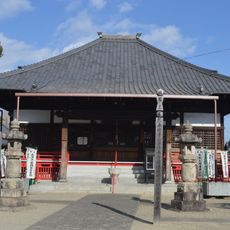
Myogen-in is a Tendai Buddhist temple in Oharu, Aichi Prefecture, known as Japan's oldest medical facility specializing in ophthalmology. Its main hall, rebuilt in reinforced concrete in 1978, replaced a 1741 structure damaged by the 1959 Ise Bay Typhoon. The grounds also hold a two-story tahōtō pagoda reduced to its lower tier after the 1891 Nōbi earthquake, and two Kamakura-period Niō statues now sheltered on the old Niō gate site.
Founded in 802 by Saichō's disciple Shōen as Gōdaisan Anyō-ji, the temple was rebuilt in the Nanboku-chō period by Kiyogen, who renamed it Iōzan Yakushi-ji. In 1357 Kiyogen began treating eye diseases after a dream revealed a secret remedy and a healing spring. In 1632 it received the name Myōgen-in after treating a daughter of Retired Emperor Go-Mizunoo, and in 1766 it became an imperially sanctioned temple.
The temple's name, Myogen-in, means "clear eye" and was granted by the imperial court after its monks treated members of the imperial family. The site is also linked to the Maishima school of ophthalmology, and the Maishima surname is still common among eye doctors in the region.
Myogen-in stands in Oharu, a 20-minute walk from Jimokuji Station on the Meitetsu Tsushima Line, or 2 minutes on foot from the Oharu Town Hall bus stop served by Meitetsu buses from Nagoya Station via Yasumatsu. The main hall was rebuilt in reinforced concrete in 1978, and the former two-storey tahoto pagoda lost its upper storey after the 1891 Nobi earthquake, so only its lower tier remains.
The temple's former study building, the Okyo-kan, was built in 1742 and later moved to the garden of the Tokyo National Museum, where it stands today. Its sliding screens were painted by Maruyama Okyo, who is said to have given the paintings in thanks for treatment he received here.
The community of curious travelers
AroundUs brings together thousands of curated places, local tips, and hidden gems, enriched daily by 94,296 contributors worldwide.