Saishō-ji, Buddhist temple in Setagaya, Japan.
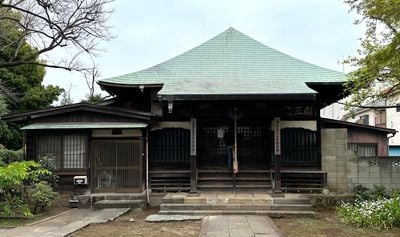
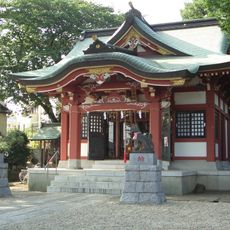
Saishō-ji, formally Takezono-san Saishō-ji Kyōgaku-in, is a Tendai temple of the Kan'ei-ji branch in Taishidō, Setagaya. Its single-story hall has a pyramidal roof of pale green tiles overhanging a dark timber facade, with a thick rope hanging before the closed central door. Two inscribed stone pillars flank the entrance, and low stone steps lead to a wooden veranda.
According to temple tradition, it was founded in 1311 by the monk Gen'o near Edo Castle's Momiji-yama, moved to Kojimachi Kaizuka when Ōta Dōkan built the castle in 1457, then to Akasaka, and in 1604 to Aoyama Minamichō on a 3,000-tsubo grant. Some scholars date Gen'o's founding to 1604. It moved to Taishidō between 1909 and 1911.
The temple's main object of worship, the Meao Fudo, is one of Tokyo's Five Colored Fudo Myoo figures, called blue-eyed Fudo. It is a hibutsu, kept hidden and never shown to visitors; the bronze Fudo Myoo in front of it, made in 1642, is what can be seen. The image came here in 1882 from the abolished Kango-ji in Azabu.
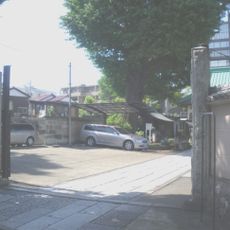
The temple sits near Sangenjaya Station and is easy to reach by the Tokyu Den-en-toshi or Setagaya Line. The grounds are accessible on foot and offer a straightforward visit without major obstacles.
The hibutsu Meao Fudo, said to be carved by Ennin, is never shown; what stands before it is a bronze Fudo Myoo image dated 1642, moved here in 1882 from the abolished Kango-ji in Azabu. The temple also keeps the graves of the Okubo lords of Odawara, Ogino-Yamanaka and Karasuyama.
The community of curious travelers
AroundUs brings together thousands of curated places, local tips, and hidden gems, enriched daily by 94,226 contributors worldwide.