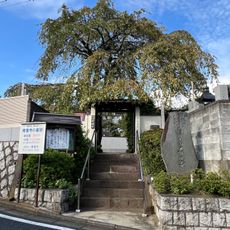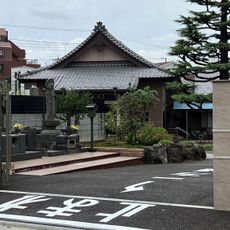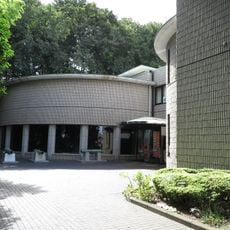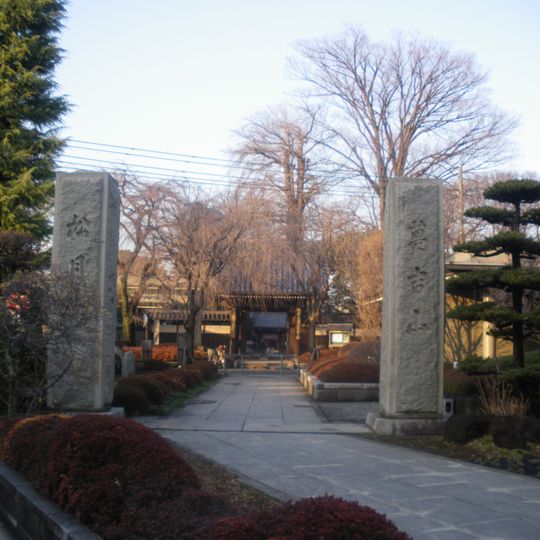
Shōgetsu-in Temple, Buddhist temple in Akatsuka, Japan.
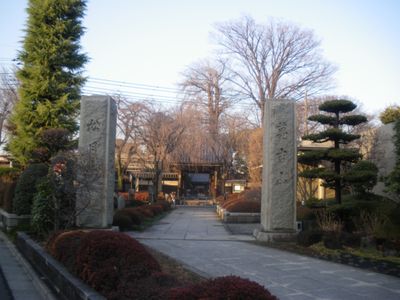
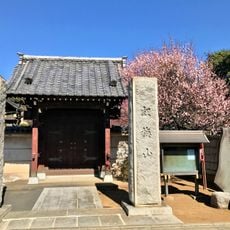
Shōgetsu-in is a Sōtō Zen temple in Akatsuka, Tokyo, formally named Manjisan Hōjiji Shōgetsu-in. Its entrance is marked by two tall, rough-hewn grey stone pillars carved with vertical characters, the left one bearing the character "松" (pine). Low reddish-brown clipped shrubs sit at their bases, and the temple grounds lie beyond.
Chiba Yoritane, a warlord based in Bōsō, moved from Ichikawa to Akatsuka Castle in 1456. In 1492 he designated the older Hōji-ji temple on this site as his family temple, donated land and had it renamed Shōgetsu-in. In the Edo period the Tokugawa shoguns granted it a 40-koku red-seal estate, and in 1841 Takashima Shūhan placed his headquarters here during Western-style artillery drills at nearby Tokumarugahara.
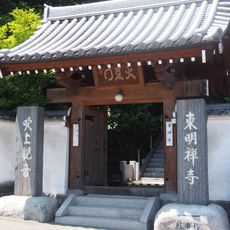
The temple's name appears on the stone gateway pillars, whose inner faces carry vertical carved characters. The novelist Shimomura Kojin, author of Jiro Monogatari, liked the Akatsuka area so much that he set parts of the novel there, often stopped at the temple, and is buried in its grounds. The temple also runs an adjacent kindergarten.
The temple is about 20 minutes on foot from Shimo-Akatsuka or Narimasu stations on the Tobu Tojo line, or from Chikatetsu-Akatsuka and Chikatetsu-Narimasu stations on the Yurakucho and Fukutoshin lines. From Narimasu station's north exit, the Kokusai Kogyo bus (route Aka 02) toward Akabane station's west exit stops at Akatsuka Hatchome. Visiting is free and limited to daytime hours.
The temple holds a memorial stone for the 1932 New Tokyo Eight Scenic Spots poll, in which readers of the Hochi Shimbun ranked Shōgetsu-in fifth, making it one of the eight. Its treasure hall, Matsuhōkaku, displays materials relating to Takashima Shūhan and the Chiba clan.
The community of curious travelers
AroundUs brings together thousands of curated places, local tips, and hidden gems, enriched daily by 95,304 contributors worldwide.