Ryūto Bridge, Box girder road bridge in Chūō-ku, Niigata, Japan
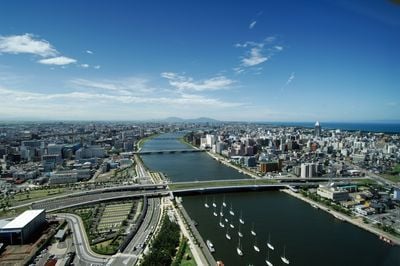
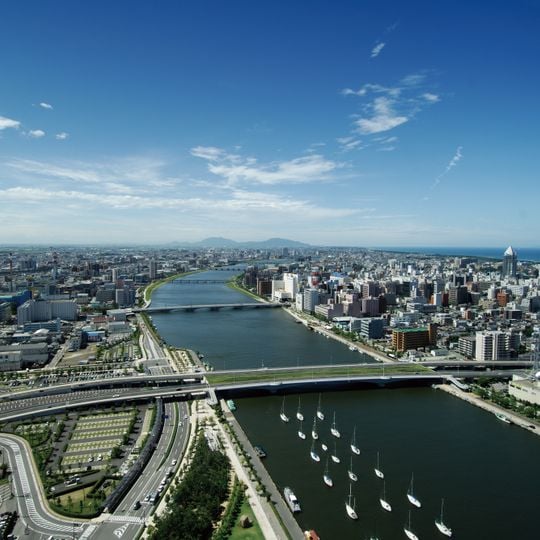
Ryūto Bridge is a 212.1-metre, three-span prestressed concrete box girder bridge over the Shinano River in Chūō-ku, Niigata. Its 40-metre deck carries four lanes plus cycle and pedestrian paths, and the girder undersides follow arch curves. The concrete is clad in fine-ceramic tiles chosen to resist salt damage from the Sea of Japan.
Residents and port workers petitioned for a downstream crossing from 1919, and a 1965 citizens' rally backed a toll bridge called Minato Ōhashi. That plan was frozen in 1975 by mayor Kihachirō Kawakami. The current bridge was built as the Bandai Bridge Downstream Bridge from 1993 and opened in spring 2002, in time for the FIFA World Cup.
The bridge links residential areas with commercial zones and serves as an ordinary crossing point in the daily movement of people through Chūō-ku. Locals pass over it without particular notice of its engineering function.
The bridge carries National Route 7 with two lanes each way, plus a 5 m bicycle and pedestrian path separated from traffic by a 1.5 m planting strip. Six stairways with slopes link the deck to Chōbori-dōri and the riverside walkways, and two elevators stand on the upstream side. Bandai Bridge is about 350 m upstream; the Niigata Minato Tunnel crosses the riverbed roughly 3 km downstream.
The bridge's ceramic tile cladding, the first used on a road bridge in Japan, was funded by 500 million yen saved through cost reductions in the project. It echoes the granite facing of the neighbouring Bandai Bridge. The bridge's name was chosen from 11,934 public entries in 2001.
The community of curious travelers
AroundUs brings together thousands of curated places, local tips, and hidden gems, enriched daily by 93,547 contributors worldwide.