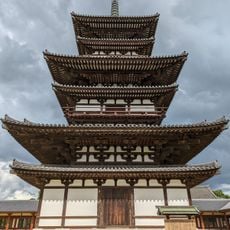
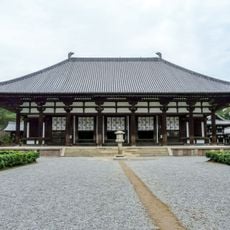
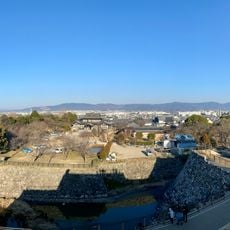
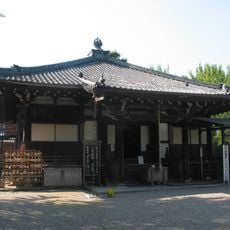
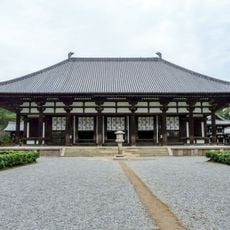
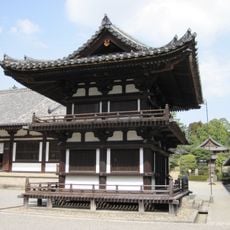
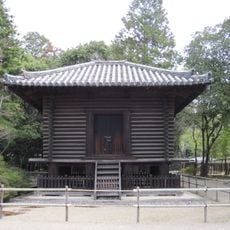
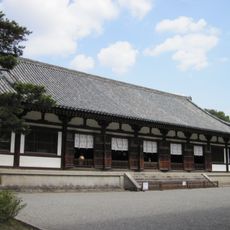
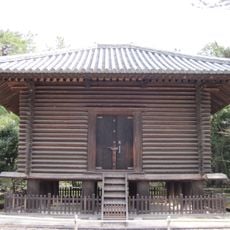
Eikei-ji, Buddhist temple in Yamatokōriyama, Japan.
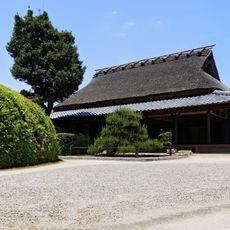
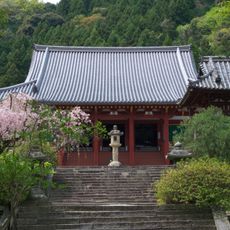
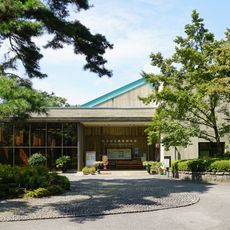
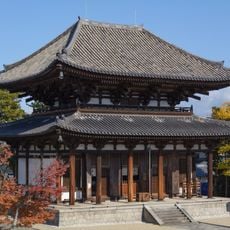
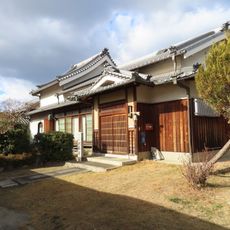
Eikei-ji stands as a traditional Zen Buddhist temple belonging to the Ōbaku school, featuring traditional Japanese architecture with its main hall, mountain gate, and meditation halls arranged in classical temple layout within carefully maintained grounds.
Yanagisawa Yoshiyasu, a senior aide to Shogun Tokugawa Tsunayoshi, founded the temple at Iwakubo in Kai Province; in 1708 he invited the Ōbaku master Eppō Dōshō and renamed it Ryūgezan Eikei-ji. The main hall was begun in 1709, and the opening ceremony took place on 10 August 1710. When the Yanagisawa moved to Yamatokōriyama in 1724, the temple followed, while the couple's remains were reburied at Erin-ji.
The temple keeps wooden portraits of Yanagisawa Yoshiyasu and his wife Sadako, made by the Kōfu sculptor Ōshita Jōkei and his sons. Yoshiyasu's statue, 85 cm tall, shows him in court dress with a sceptre and a sword inscribed Yamashiro no Kami Kunishige; his wife's 80.8 cm figure holds a fan. Both are displayed in the temple's Buddhist room.
The temple lies in the Eikei-ji-chō district of Yamatokōriyama, Nara Prefecture, in the Kinai region south of Nara. It stands on the site to which the temple was moved in 1724, when the Yanagisawa clan was transferred from Kai to Yamatokōriyama. Visitors should look for the temple under its full name, Ryūge-zan Eikei-ji, since it shares its name with other temples in Japan.
The temple's two portrait statues of Yanagisawa Yoshiyasu and his wife, 85.0 and 80.8 cm tall, were carved by the Kōfu sculptor Ōshita Jōkei, whose ancestor made the Takeda Shingen statue at Erin-ji. The couple's remains were later reburied at Erin-ji, not here.
The community of curious travelers
AroundUs brings together thousands of curated places, local tips, and hidden gems, enriched daily by 93,402 contributors worldwide.