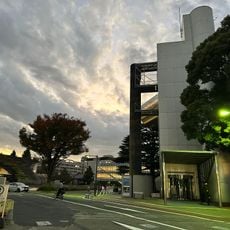
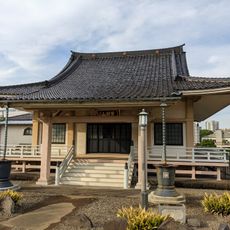
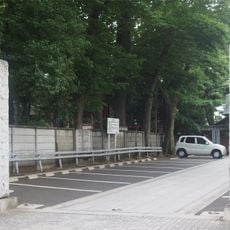
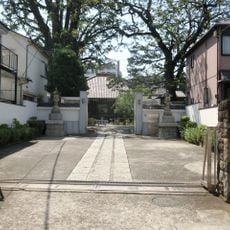
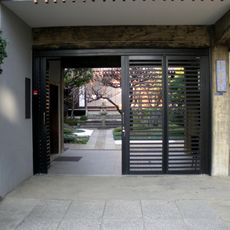
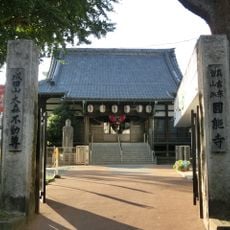
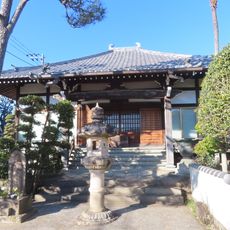
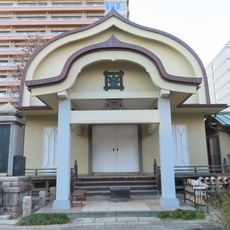
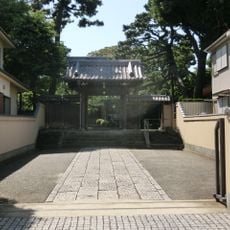
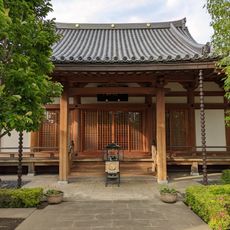
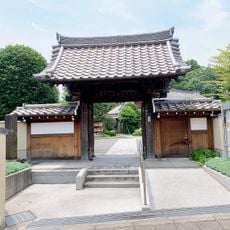
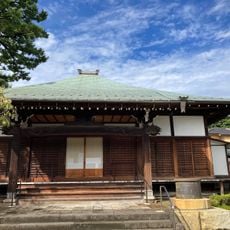
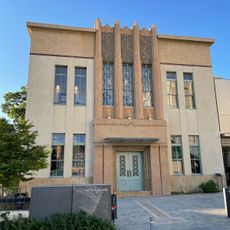
Horen-ji, Buddhist temple in Shinagawa-ku, Japan.
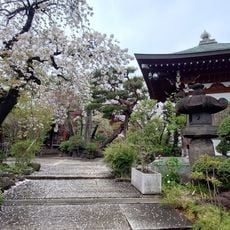
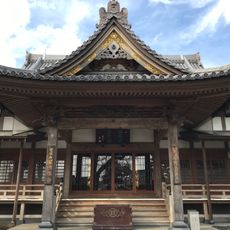
Horen-ji is a Nichiren Buddhist temple in the Takanawa area of Shinagawa, Tokyo. Its main hall and Ebisu hall are postwar reconstructions, the original buildings having burned in the 1945 air raids. The temple stands next to Hataoka Hachiman Shrine, of which it was once the betto-ji, and houses an Ebisu deity of the Ebara Seven Lucky Gods.
Horen-ji was founded after Ebara no Yoshimune, a descendant of Minamoto no Yoshiie who ruled this area, converted to Nichiren Buddhism and placed his son Tokujiro under Nichiro, a leading disciple of Nichiren. Tokujiro became the monk Ryokei and founded the temple on the site of the Ebara family residence. It served as the betto-ji of the neighbouring Hataoka Hachimangu, and in the Edo period that shrine became a prayer site of the second shogun Tokugawa Hidetada. The original buildings burned in the 1945 air raids and were rebuilt after the war.
Horen-ji is the betto-ji, the temple managing the neighbouring Hataoka Hachimangu shrine, and one of the Ebara Seven Lucky Gods: its Ebisu hall honours the deity of fishermen and merchants. The temple belonged to the Nakano-fu lineage of Ikegami Honmon-ji, and its 39th abbot, Nichisen, was popular in the Ooku of Edo Castle.
Horen-ji is a one-minute walk from Ebara-machi Station on the Tokyu Oimachi Line. Admission to the grounds is free. The temple stands in Togoshi, Shinagawa-ku, next to Hataoka Hachiman Shrine, which it once served as betto-ji.
Horen-ji served as the betto-ji, the temple managing the adjacent Hataoka Hachimangu shrine, and the shrine's Ebisu deity is one of the seven Ebara lucky gods. The Edo-period priest Nisshin, the 39th abbot, was popular even within the Ooku of Edo Castle. The temple appears as "Horen-ji" in Saito Gesshin's Edo Meisho Zue, drawn in the Tenpo era.
The community of curious travelers
AroundUs brings together thousands of curated places, local tips, and hidden gems, enriched daily by 94,045 contributors worldwide.