Muryōkō-in Ato, Archaeological site and former Buddhist temple in Hiraizumi, Japan
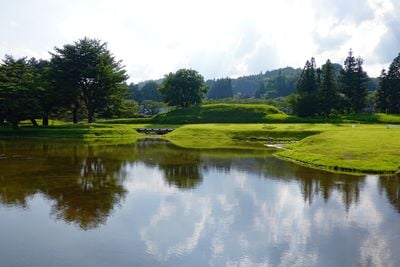
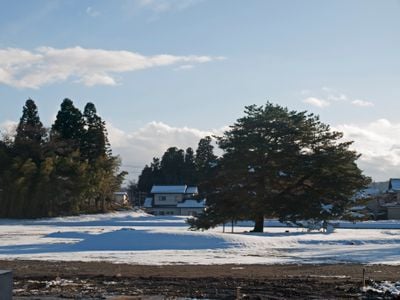
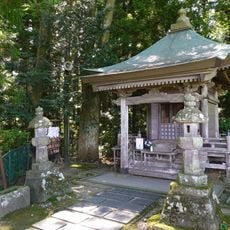
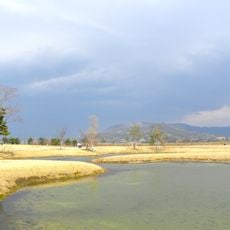
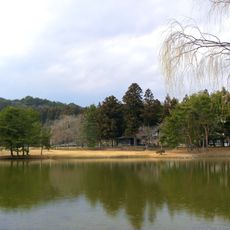
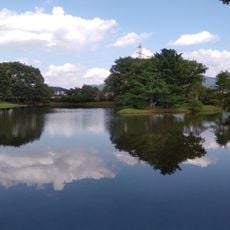
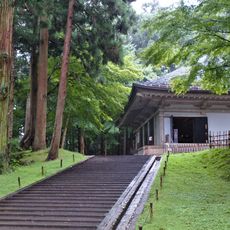
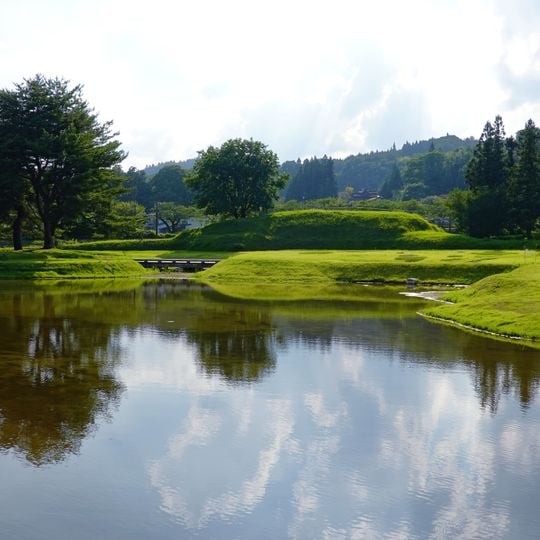
Muryōkō-in Ato is the site of a temple built by Fujiwara no Hidehira in the late Heian period, modelled on Byōdō-in in Uji but larger, covering about 6.5 hectares (240 m east-west by 270 m north-south). Excavations revealed the main hall's foundations, a pond with a central island, and earthen embankments; today a low grassy mound and a small wooden structure stand near still water, with foundation stones and pine woods across the grounds.
Fujiwara no Hidehira, third head of the Ōshū Fujiwara, built Muryōkō-in in the late Heian period, modeling it on Byōdō-in in Uji and calling it Niimidō. The precinct measured about 240 m east-west by 270 m north-south, roughly 6.5 ha, larger than Byōdō-in. Repeated fires after the clan's fall left only earthen embankments and foundation stones; excavations in 1952 confirmed the layout described in the Azuma Kagami, and the site became a Special Historic Site in 1955.
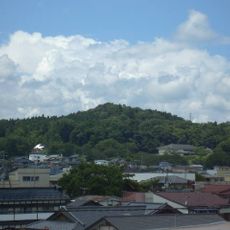
The temple was called Shin-mi-dō, meaning the new hall of Mōtsū-ji, and was built by Fujiwara no Hidehira in imitation of Byōdō-in in Uji. Its main hall faced east so that the setting sun would sink behind Mount Kinkei, a design expressing Pure Land thought. Excavations show the precinct measured about 240 by 270 metres, larger than Byōdō-in.
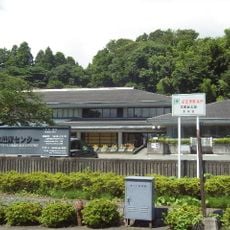
The site is easily accessed from Hiraizumi and has informational panels explaining the temple layout and historical background. Plan to spend time walking the grounds to understand how the buildings were arranged.
Unlike Byōdō-in, the precinct had tiles laid in front of the central hall and an island in its pond. The main hall matched the Phoenix Hall's size, but its side corridors were one bay longer. Excavations from 1952 confirmed these details recorded in the Azuma Kagami.
The community of curious travelers
AroundUs brings together thousands of curated places, local tips, and hidden gems, enriched daily by 95,024 contributors worldwide.