Rengebu-ji, Buddhist temple in Sado, Japan.
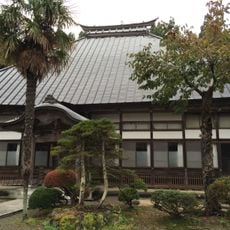
Rengebu-ji is a Shingon Buddhist temple in a valley on Sado Island, with a Kondō hall built before 1459 at its center. The Kondō has an irimoya roof and walls painted with 33 Kannon in Sanskrit. The compound also holds a 1609 Kōbō-dō and an ossuary built before 1348, the oldest building in Niigata Prefecture.
Tradition attributes the temple's founding to Kūkai in 806, when Sado was seen as lying on the capital's northeastern axis and the site was opened to protect the imperial palace; some accounts give 807, and others credit early 9th-century Tendai monks. The Kondō hall was built before 1459, when a pilgrim's ink inscription was left on a wall board. In 1652 the Kompie disturbance, a revolt by the Aikawa magistrate Tsuji Tōzaemon, ended with his family besieged here and the abbot executed.
The temple is known as the Hydrangea Temple: about 7,000 hydrangea plants grow in the grounds, and an Ajisai Matsuri is held when they flower in mid-July. The temple is the sixth stop on the Sado Shikoku 88-temple pilgrimage, and the grounds also hold a sugi grove and azaleas.
Rengebu-ji lies about 3 km north of the Ogi port ferry terminal, roughly 40 minutes on foot, or 2 km north of the Ogi Onsen-mae bus stop, about 30 minutes on foot. By car it is some 0.5 km from National Route 350, and parking is provided near the grounds.
The Kondō's walls carry thirty-three Kannon figures written in Sanskrit characters (bonji). During dismantling repairs, a pilgrim's ink inscription dated 1459 was found on the back of a wall panel, which is how the hall's construction is dated to the Ōei era (1394–1428).
The community of curious travelers
AroundUs brings together thousands of curated places, local tips, and hidden gems, enriched daily by 94,365 contributors worldwide.