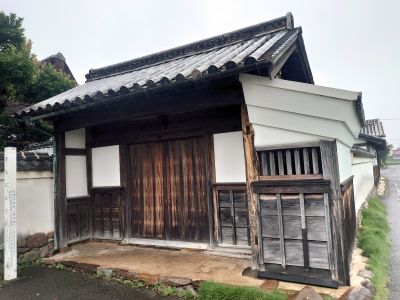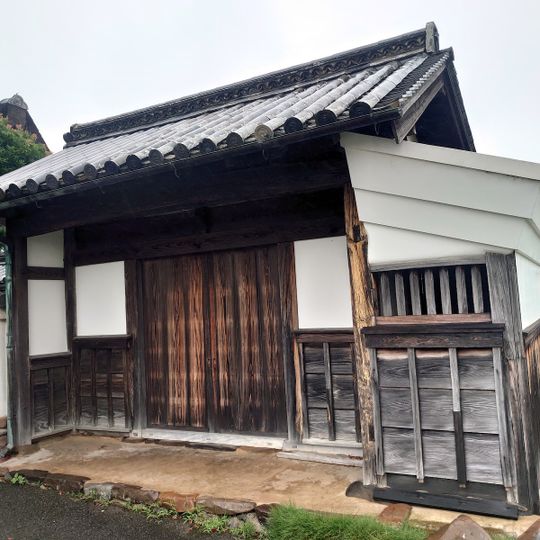
Toshima Family Residence, Important Cultural Property in Matsuyama, Japan.
The Toshima Family Residence is a traditional wooden house built in the yatsumune-zukuri style, comprising seven separate structures connected as one property. The compound includes a rice storehouse and demonstrates the building methods used by prosperous rural families during that period.
The main house was built in 1758, as shown by an ink inscription on a lintel found during repairs; the gate dates from the mid-18th century and the nagaya-mon from the late Edo period. The Toshima family, wealthy farmers of ōshōya rank, were ordered to breed horses for the domain, and the surviving nagaya was converted from a stable into living rooms. The rice storehouse was added in 1917.
The Toshima family were major landowners of shōya rank, and the shogunate's inspection envoy lodged in a surviving zashiki room. The compound also kept a stable for domain military horses; the present nagaya was converted from that stable into living quarters. The main house's linked wings form the so-called "Ido no Yatsumune-zukuri".
The residence is normally closed to the public, so visits must be arranged in advance; it stands at 421-1 Idonmachi, Matsuyama, Ehime 791-1114. The main house and its attached structures were dismantled and repaired between 1972 and 1979.
The residence deliberately combines living quarters with specialized areas for managing agricultural operations as an integrated part of the design. This mixing of home and work reflects how landowners structured their daily routines.
The community of curious travelers
AroundUs brings together thousands of curated places, local tips, and hidden gems, enriched daily by 94,578 contributors worldwide.