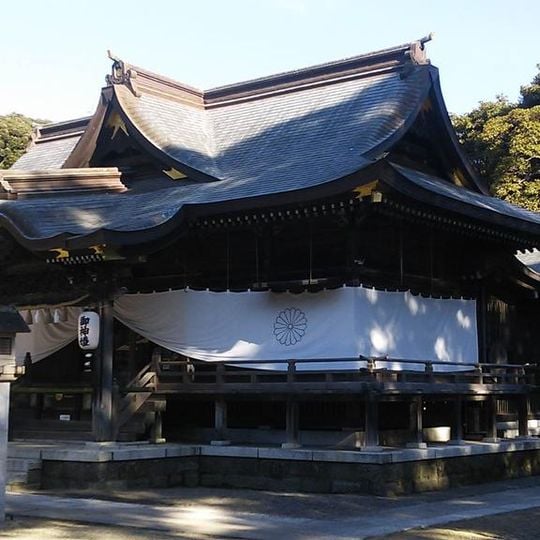
Sakatsura Isosaki Shrine, Shinto shrine in Isozaki, Hitachinaka, Japan
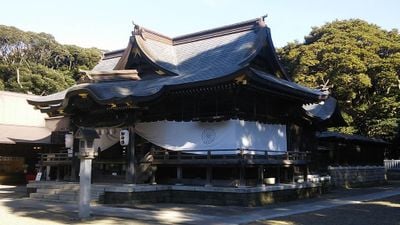
Sakatsura Isosaki Shrine stands on a hill above the Pacific in Hitachinaka. Its worship hall is an irimoya-zukuri building with a chidori-hafu porch and karahafu gable; the main sanctuary is nagare-zukuri, facing west. A carved squirrel-and-grape motif attributed to Hidari Jingoro decorates the worship hall, and a white cloth banner with a multi-petaled emblem hangs across the front.
According to the Nihon Montoku Tennō Jitsuroku, in 856 a deity appeared at Oarai Isosaki on the Kashima coast; Ōnamochi was enshrined at Oarai and Sukunahikona at Sakatsura. The shrine appears in the Engishiki as a Myōjin Taisha, but fell into ruin in the Middle Ages. Tokugawa Mitsukuni began rebuilding it, and in 1702 Tokugawa Tsunaeda moved it to its present site.
The shrine is nicknamed "Ubago-sama" (nurse deity) and its grounds are a natural monument of broadleaf trees. The name Sakatsura comes from a coastal rock formation tilted northward, the "reverse row" (sakatsura), later written with the character for sake because the deity Sukunahikona is a god of brewing. A white cloth banner with a multi-petaled emblem hangs across the front, and a plaque reading 御神燈 is fixed by the steps.
The shrine stands on a headland above the Pacific, about 15 minutes on foot from Ajigaura Station, the terminus of the Minato Line. The roughly 300-metre approach is lined with camellias and evergreen oaks, a grove designated a prefectural natural monument. The former site, near the first torii, is marked by a small shrine.
The shrine is nicknamed "Ubago-sama" (nurse deity), and its grounds hold a stone said to have been sat on by Tokugawa Nariaki, plus a monument to the local figure Isosaki Tanekichi. The worship hall carvings of squirrels and grapes are attributed to the Edo-period sculptor Hidari Jingoro.
The community of curious travelers
AroundUs brings together thousands of curated places, local tips, and hidden gems, enriched daily by 93,554 contributors worldwide.