Kaimon Bridge, Road bridge in Japan
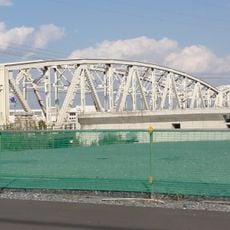
Kaimon Bridge is a road bridge crossing the mouth of the Naka River, linking Kaimoncho in Hitachinaka with Isomachi in Oarai, Ibaraki Prefecture. The current fifth-generation structure, 407.8 m long and 7.5 m wide, is a steel simple through Langer truss and steel simple composite plate girder bridge. Its central span of 90 m and clearance of 15 m allow ocean-going fishing boats to pass beneath; it rests on 12 piers.
A ferry ran at this spot from at least the Edo period, operated by Gan'nō-ji temple and later by the Mito domain; in 1865 it carried 220,092 paying passengers. The first Kaimon Bridge, a wooden toll bridge 218 m long that could open for boats, opened on 9 November 1895 and was swept away by a flood in September 1896. The fourth bridge, a concrete arch opened in 1930, collapsed on 30 June 1938 when its Aōi-side pier, built on shallow pine piles, tipped over. The fifth and present bridge opened on 20 July 1959.
The name Kaimon Bridge has no known originator. The fourth bridge, opened in 1930, was called the "rainbow bridge" by those who saw it, and the novelist Koyama Itoko based a novel titled Kaimon Bridge on the foundation problems of its construction. The bridge also carried the Suihama tram line until the line's end at Oarai.
The bridge carries the Nakaminato-Oarai prefectural road between Hitachinaka and Oarai; the central span is 90 m wide and 15 m above the water so ocean-going fishing boats can pass beneath. It has 12 piers and a total length of 407.8 m. The former fourth bridge stood downstream, and a small part of its foundation remains on the Oarai bank.
The fourth bridge, completed in 1930, was already tilting during construction; author Koyama Itoko based a novel on the foundation problems. It collapsed in 1938, and part of its foundation still remains on the Oarai riverbank downstream of the present bridge.
The community of curious travelers
AroundUs brings together thousands of curated places, local tips, and hidden gems, enriched daily by 93,553 contributors worldwide.