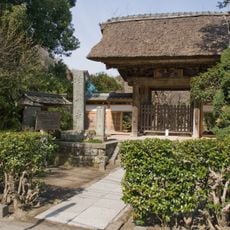
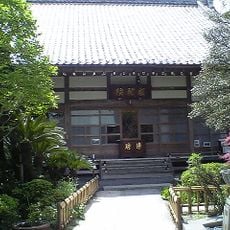
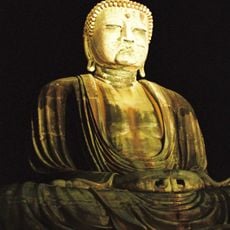
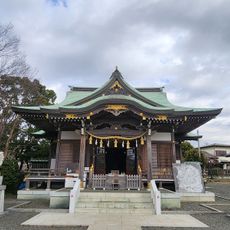
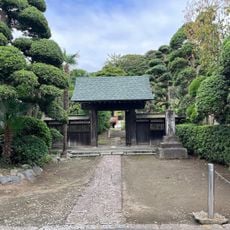
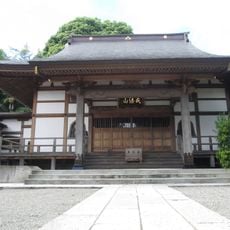
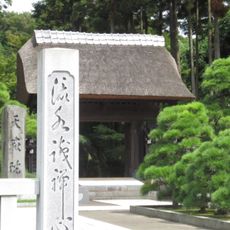
Shōren-ji, Buddhist temple in Kamakura, Japan.
Shōren-ji is a Shingon temple of the Kōyasan school in the Tebiro district of Kamakura, formally named Iimoriyama Niōin Shōren-ji. Its main image is a Kamakura-period wooden seated statue of Kōbō Daishi, a National Important Cultural Property, whose joints are linked by chains so it can be moved. The temple grounds also contain the rebuilt sub-temple Hōshaku-in, a underground ossuary, and a stone Jizō called Tsubaki Jizō about 200–300 meters away near the Tebiro intersection.
Shōren-ji was founded in 819 by Kūkai (Kōbō-Daishi) and rebuilt in the Chōroku era by Zenkai. In 1591 Tokugawa Ieyasu granted it 25 koku in Tebiro village, and it was listed among the 34 Kantō Danrin temples. A fire in 1833 and the Great Kantō earthquake destroyed buildings and scattered records, leaving many details unknown.
The temple's name comes from a legend: Kūkai, training on Mount Iimori behind the temple, received a relic from a heavenly maiden and woke to find blue lotus flowers blooming everywhere. The main image, a Kamakura-period seated Kūkai, is a hibutsu opened five times a year, including New Year's Eve. Nearby, the Tsubaki Jizō is visited for healing warts, and a festival is held beside it every 14 August.
Shōren-ji stands along the Koshigoe-Ōfuna line (Kanagawa Route 304) and the old Enoshima road; the Enoden bus stop "Kusari Daishi" is named after the temple's main image. A tunnel that once led from the old Enoshima road to the temple was cut away when Route 304 opened and is now sealed at its entrance. Near that spot stands a Kōshin-tō stone tower, and the Tsubaki Jizō statue, managed by the temple, sits by the Route 304 Tebiro intersection.
The main image, a wooden seated Kōbō Daishi from the Kamakura period, is a National Important Cultural Property whose knee and other joints are linked by chains so the limbs can be moved; it is known as the "Chain Daishi". It is normally kept hidden and shown five times a year, including New Year's Eve. It came from Tsurugaoka Hachimangū after the Meiji-era persecution of Buddhism.
The community of curious travelers
AroundUs brings together thousands of curated places, local tips, and hidden gems, enriched daily by 94,302 contributors worldwide.