Takasu-jinja, Shinto shrine in Japan
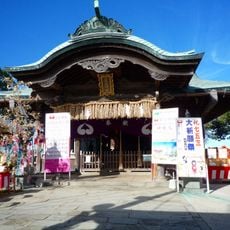
Takasu-jinja stands at the western foot of Mount Takasu in Itoshima. Its main hall is a three-bay nagare-zukuri building with a cypress-bark roof, rebuilt in 1662 by Kuroda Mitsuyuki, the third lord of Fukuoka Domain, possibly reusing older pillars. In front of it stands a 1731 worship hall with a cypress-bark roof, and below them a granite Myojin torii about five metres high.
The shrine appears in records in 877, when the deity Takaiso-hime was promoted in rank. The present main hall dates essentially from 1662, when Fukuoka domain lord Kuroda Mitsuyuki rebuilt it, reusing older pillars; it was repaired from 2013 to 2016 and designated a National Important Cultural Property in 2023.
The shrine is also known as Takasu-gu. Its name is linked to the lost deity Takaiso-hime, identified in records from 877, and theories connect her to the immigrant Amenohiboko legend. Twice a year, in spring and autumn, Takasu-kagura is performed: twelve dances in two types, dance-kagura and mask-kagura, said to have been brought from Kyoto in 1467.
The shrine is about 30 minutes on foot from JR Kyushu's Shusenji Station on the Chikuhi Line, or take the Kawahara community bus to the Takasu stop and walk about 5 minutes. The grounds sit on the western foot of Mount Takasu, with the main hall and worship hall on an upper level reached by stone steps.
Takasu-kagura was introduced from Kyoto in 1467 by Harada Tanekane, lord of Takasu Castle. It comprises twelve pieces in two types: mai-kagura, a silent dance without masks, and men-kagura, masked performances of mythic stories. Designated a Fukuoka Prefecture intangible folk cultural property in 1981, it is performed at the spring and autumn festivals.
The community of curious travelers
AroundUs brings together thousands of curated places, local tips, and hidden gems, enriched daily by 94,036 contributors worldwide.