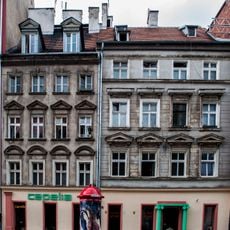
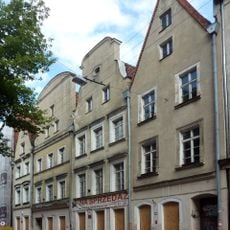
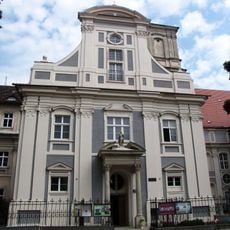
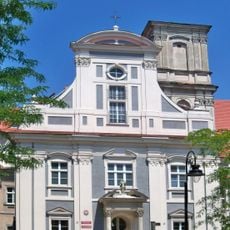
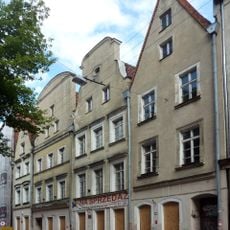
48 Szewska Street, Wrocław, Baroque palace in the Old Town of Wrocław, Poland
The Hornes Palace at 48 Szewska Street is a three-storey baroque town palace built after 1721 for Count Dionysius Joseph von Hornes, probably to a design by Johann Blasius Peintner or Christoph Hackner. Its seven-axis facade centres on a sandstone balcony portal with acanthus ornament, two rusticated pilasters and a baroque grille, topped by a volute-flanked dormer. Surviving medieval walls, two bays of rib vaults and a Gothic south gable remain.
The plot's first building dates to the second half of the 14th century, with cellar-level wall fragments still preserved. In 1721 Baron von Sternbach sold the property to Count Dionysius Joseph von Hornes, who had the old house demolished and a new three-winged town palace built, probably designed by Johann Blasius Peintner or Christoph Hackner. Damaged in 1806–1807 during fighting between the Prussian garrison and Napoleonic troops, it was rebuilt in classicist forms.
The palace takes its name from Count Dionysius Joseph von Hornes, who bought the plot in 1721 and had the old building replaced. Later it passed to the von Matusch family, hence its second name, Pałac Matuschków. Since 1945 it has housed university departments, and a blind window on the facade bears an image of the poet Angelus Silesius.
The building is located in central Wrocław near the Old Town and is easy to find. Its position in a busy neighborhood makes it convenient to visit while walking through the city.
In one of the blind windows of the facade, a portrait of Angelus Silesius was placed during the 2016 renovation. The building has housed the Department of Archaeology and the Dean's Office of the Faculty of Historical and Pedagogical Sciences of the University of Wrocław since the 1980s.
The community of curious travelers
AroundUs brings together thousands of curated places, local tips, and hidden gems, enriched daily by 94,354 contributors worldwide.