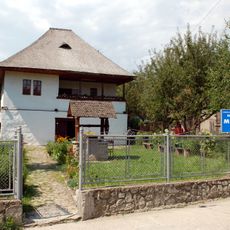
Brebu Monastery, Medieval monastery in Prahova County, Romania.
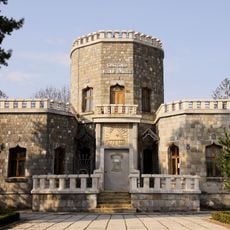
Brebu Monastery is a walled complex built under Matei Basarab, with a triconch church measuring 30 by 10 metres, two-metre-thick walls of burnt brick and stone, and three towers. Its irregular octagonal enclosure wall stands six metres high, and the southern entrance tower rises about 20 metres over three levels. The church door and window frames were carved by master Lupu in a late Moldavian Gothic style.
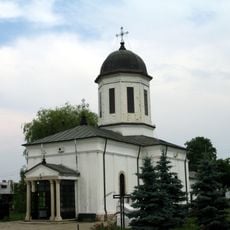
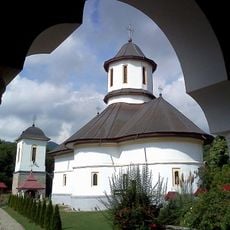
Construction began before 27 November 1640, when Matei Basarab's chancery already called Brebu a monastery raised from its foundations by his rule; a patriarchal act of April 1641 confirmed this. The long inscription in the pronaos instead gives 27 June 1650, which some researchers read as the completion date, the delay being blamed on the wars with Vasile Lupu and the seimeni revolt. The church, dedicated to the Archangels Michael, Gabriel, Azrael and Raphael, was functional by 1641. After Matei's death, forced land seizures soured locals on the monastery, which fell into neglect; Constantin Brâncoveanu found it in a sorry state.
The monastery is dedicated to the Archangels Michael, Gabriel, Azrael and Rafail, a dedication recorded in the documents of Matei Basarab's chancellery. The long inscription kept intact in the pronaos names the monk Vasilie as first hegumen. The interior painting of the altar and iconostasis was redone in 1843 and repainted by Sava Henția in 1901–1902, who also repainted part of the tower's inner walls.
The complex is entered through the southern access tower, about 20 m high, which served as an observation point; the enclosure wall is roughly octagonal and 6 m high. The cells and annex buildings once stood on the western side, and their former site is marked by the restoration works completed in 1963. The church interior was repainted in 1843 and again by Sava Henția in 1901–1902.
The entrance tower, about 20 m high, served partly as an observation post; its first two floors have loopholes for firearms, while the open third floor holds the bells. Part of its interior walls were repainted by Sava Henția, who also restored the church painting in 1901–1902.
The community of curious travelers
AroundUs brings together thousands of curated places, local tips, and hidden gems, enriched daily by 94,109 contributors worldwide.