Cantacuzino Palace in Florești, Prahova, Romania, Historic monument in Florești, Romania
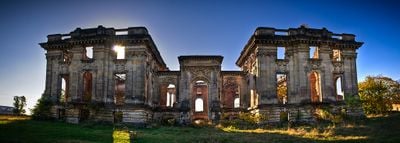
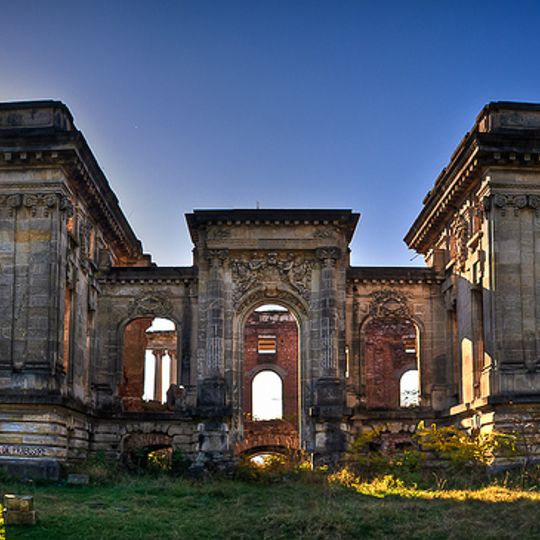
Cantacuzino Palace in Florești is an unfinished three-level palace (basement, ground floor, upper floor) built of brick and clad in white Albești limestone. Its west facade has ten paired Neoclassical columns, except at the ends, closing a terrace; the east facade carries a bas-relief of two angels holding the family coat of arms above the entrance. The basement walls are 80 cm thick, the upper walls 60 cm.
Construction of the palace began in 1911 using modern techniques such as reinforced concrete, making it an example of contemporary building methods. The structure experienced damage and abandonment over the decades that followed, leading to gradual deterioration.
The palace's nickname, "Little Trianon", comes from its model, the Petit Trianon at Versailles, and the garden was laid out by French landscaper Emile Pinard in the "à la française" manner, descending in terraces from a now-dry basin toward the Prahova floodplain. Maria Tescanu Rosetti, wife of George Enescu, described flowerbeds, clipped hornbeams and French-style fountains, with a separate small house for each child.
The location sits on a hilltop with views across the valley and is best explored on foot from surrounding paths. Visitors should respect the property boundaries as the structure is damaged in places and can only be seen from outside.
The garden was designed by a French landscape architect in the formal style with terraced levels stepping down toward the valley. This European garden tradition remains visible in how the land is shaped around the mansion.
The community of curious travelers
AroundUs brings together thousands of curated places, local tips, and hidden gems, enriched daily by 94,352 contributors worldwide.