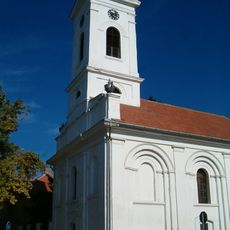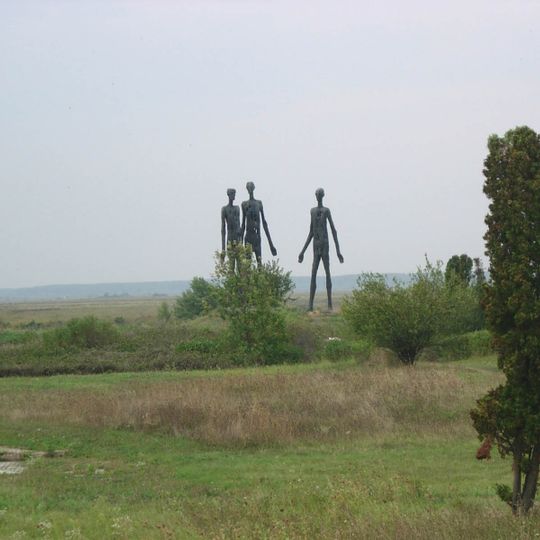
Black Ćuprija, World War II memorial complex in Žabalj, Serbia.
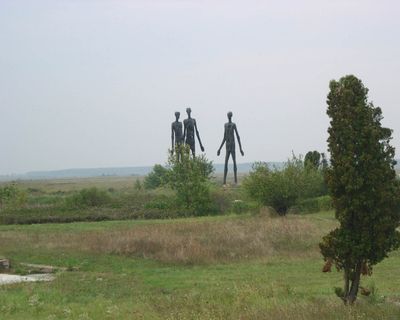
Black Ćuprija is a memorial complex with concrete sculptures positioned along a road between two major cities, occupying a large site on the landscape. The structures vary in their forms and heights, creating a visual impression across the extended grounds.
In January 1942, Hungarian fascist forces shot patriots from the Žabalj municipality here, as part of the Novi Sad Raid against Serbs and Jews in southern Bačka. In 1962, sculptor Jovan Soldatović erected a 9-metre monument to the victims of the raid and to the People's Liberation Struggle of the Šajkaška region. The complex was declared a Historic Landmark of Great Importance in 1991.
The name Crna Ćuprija means "Black Bridge". Near Jovan Soldatović's monument stands a flower-shaped sculpture by Vladislav Rajčetić, surrounded by five marble plaques listing the Žabalj victims of fascism; the original bronze flower and plaques were stolen in 2009 and the plaques later replaced in marble.
The complex lies 10 km from Žabalj on the Novi Sad–Zrenjanin road, near the Tisa River, so it is reached by car rather than on foot from town. Its grounds cover 472 hectares, with the Soldatović monument and the water-lily memorial set apart; plan transport between them. The golf centre opened in the complex in the early 21st century.
The memorial's centrepiece is a 9-metre sculpture by Jovan Soldatović, unveiled in 1962. Nearby stands Vladislav Rajčetić's stylised water-lily flower, once bronze, surrounded by five marble plaques listing Žabalj's fascist victims; the bronze was stolen in 2009 and the plaques replaced in marble. A golf centre now occupies part of the 472-hectare complex.
The community of curious travelers
AroundUs brings together thousands of curated places, local tips, and hidden gems, enriched daily by 94,639 contributors worldwide.