Gorodok, Hillfort and archaeological site in Zvenigorod, Russia
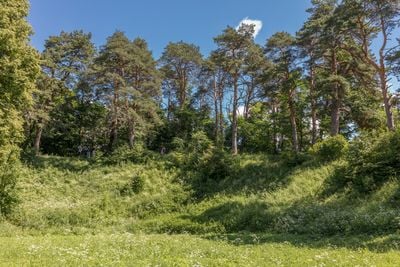
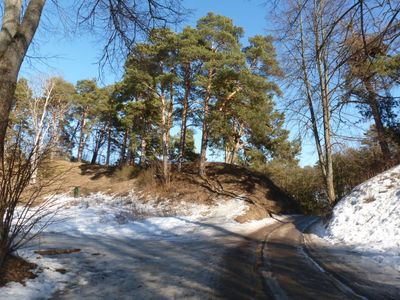
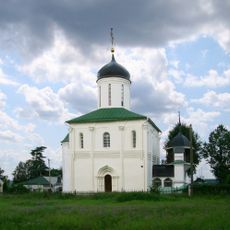
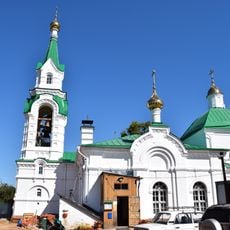
Gorodok is the old kremlin of Zvenigorod, on a hill 20–25 m high on the left bank of the Moskva River, above the mouth of the Zhernovka stream. Its earthen rampart, up to 8 m high with a slope of about 70 degrees, runs along the field side and is topped by trees; the Assumption Cathedral stands on the hilltop within the former walls.
Archaeology shows a fortified settlement here from the second half of the 12th to the early 13th century. In 1339 Ivan Kalita's will left Zvenigorod to his son Ivan, making it the centre of a principality. From 1389 Prince Yuri Dmitriyevich lived here almost constantly until 1425 and had earthen ramparts 8 m high thrown up; the town was taken by the Tatars in 1382 and 1408 and burned during the Time of Troubles.
Locals call the site gorodok, meaning 'small town'. Prince Yuri Dmitriyevich built a wooden palace with a gilded roof at its centre in 1395, and around 1399 the white-stone Assumption Cathedral rose beside it, linked to the palace by a passage. The cathedral's interior paintings are attributed to Andrei Rublev.
The site lies on the high left bank of the Moskva River, west of the modern town centre, beside the river embankment road. The climb to the ramparts is steep, and the earthen slopes become slippery when wet, so sturdy footwear helps. The Assumption Cathedral stands on the hilltop within the earthworks.
Although the fortress was abandoned over the centuries, the earthen ramparts survived almost unchanged, which is rare among medieval fortifications in this region. This made the site a reference point for archaeologists studying how medieval Russian defenses were built.
The community of curious travelers
AroundUs brings together thousands of curated places, local tips, and hidden gems, enriched daily by 93,138 contributors worldwide.