Center of Asia, Obelisk monument in Kyzyl, Russia
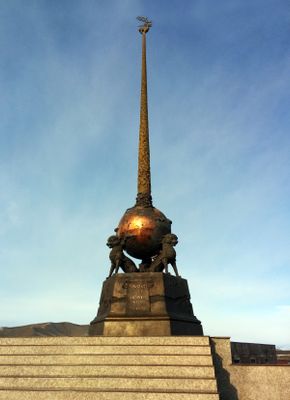
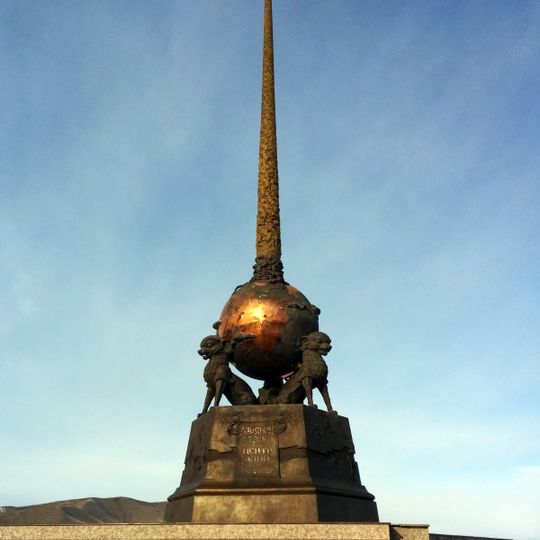
The Center of Asia is a monument on the left bank of the Yenisei in Kyzyl, Tuva. Its tiered base carries a dark sphere gripped by four bronze felines, with a slender column rising from the top. The base bears the inscriptions "ЦЕНТР АЗИИ" and "KYZYL" above a decorative band. The 2014 version was designed by Buryat artist Dashi Namdakov.
Engineers determined in the early 20th century that Kyzyl sits at the geographical midpoint of Asia, which led to the construction of the first marker. The sculpture was rebuilt several times over the following decades, most recently in 2014, while keeping the core design.
The structure displays carved dragons and other animals that carry symbolic meaning in Tuvan tradition. These figures are cut directly into the stone and form a continuous pattern across multiple faces of the construction.
The obelisk stands on the left bank of the Yenisei, just below the confluence of the Big and Small Yenisei, at the end of Komsomolskaya Street. From the monument you can see the two rivers joining. The area around it was landscaped in 1984 and the embankment rebuilt in 2014, so the approach is on foot along paved ground.
The 1964 obelisk carried a map of Tuva inlaid with precious and semi-precious stones, the centre marked by a gilded stone; that map has not survived. The present monument, designed by Buryat sculptor Dashi Namdakov and installed in 2014, shows twelve cosmogonical animal figures forming the Buddhist horoscope. Nearby stands Namdakov's bronze group "Tsar's Hunt" and the marble "My Home" by Kyrgyz sculptor Ibragim Zhusupov, second prize at Kyzyl's first international sculpture symposium in July 2014.
The community of curious travelers
AroundUs brings together thousands of curated places, local tips, and hidden gems, enriched daily by 93,345 contributors worldwide.