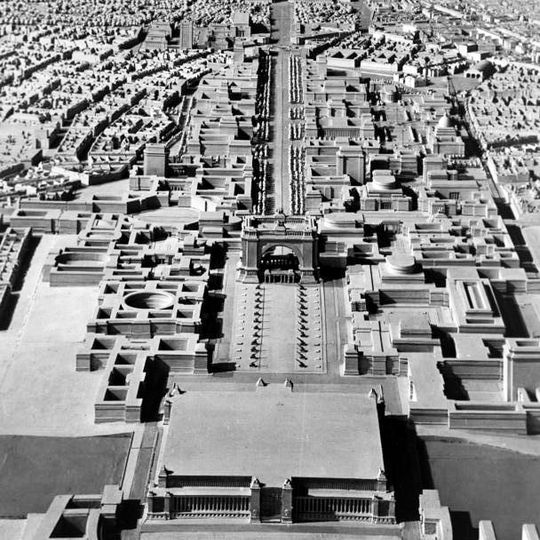
Welthauptstadt Germania, Planned Nazi capital city in Berlin, Germany
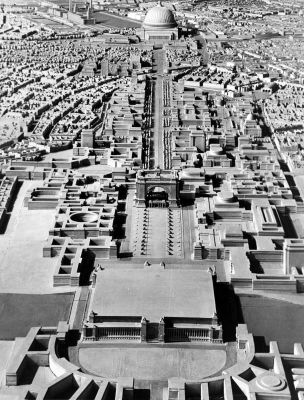
Welthauptstadt Germania was a planned city project designed to reshape Berlin into a capital with monumental buildings, wide boulevards, and massive structures on an unprecedented scale. The project included grand public spaces connected by wide streets and plazas that would link government and civic buildings throughout the city.
From 1938 to 1943, architect Albert Speer directed the initial planning and began demolishing sections of Berlin to make space for the new construction. World War II halted the project before most of it could be realized.
The buildings were designed to display power and control through their enormous scale and imposing forms. Public spaces like the planned Volkshalle were meant to host large gatherings and reinforce ideology through architecture.
Today you can see the Schwerbelastungskörper in Tiergarten, a large concrete cylinder built to test if the swampy ground could support the weight of the proposed structures. The site is located centrally and accessible on foot, with information boards explaining its purpose.
The north-south axis boulevard was designed to be 120 meters (390 feet) wide and stretch 5 kilometers through central Berlin. Underground traffic tunnels were planned to flow beneath the major public spaces, allowing vehicles to move without interrupting the areas above.
The community of curious travelers
AroundUs brings together thousands of curated places, local tips, and hidden gems, enriched daily by 91,522 contributors worldwide.