St. Ludgerus, Heritage church building in Rheine, Germany.
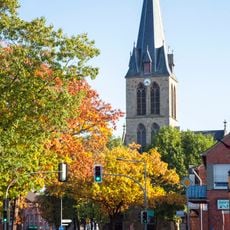
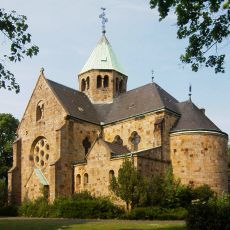
St. Ludgerus is a Neo-Romanesque basilica featuring three aisles with red and gray arches, east and west transepts, and four flank towers, rising to about 102.5 meters in height. The structure spans approximately 90 meters in length and 39 meters in width, making it the largest church building in the city.
This Neo-Romanesque basilica was constructed between 1899 and 1905 during a period of industrial growth in northern Münsterland. The building replaced the earlier St. Dionysius parish church, marking a significant shift in the religious and urban development of the area.
The church has served as a gathering place for the local community since its completion, with its seven large steel bells surviving both World Wars as symbols of continuity. These bells still mark the rhythm of daily life in the city through their ringing during services and celebrations.
The interior can accommodate about 650 people, making it spacious enough for large gatherings and services. The high ceilings and solid stone construction create a sense of space and solidity that is immediately apparent when entering.
The crypt beneath the main structure contains a small museum displaying liturgical objects and church artifacts from different periods. Each November this underground space transforms into a Christmas display featuring more than one hundred Nativity figures arranged throughout the area.
The community of curious travelers
AroundUs brings together thousands of curated places, local tips, and hidden gems, enriched daily by 90,846 contributors worldwide.