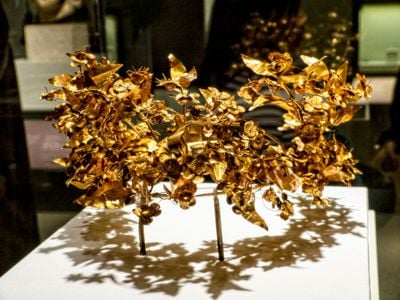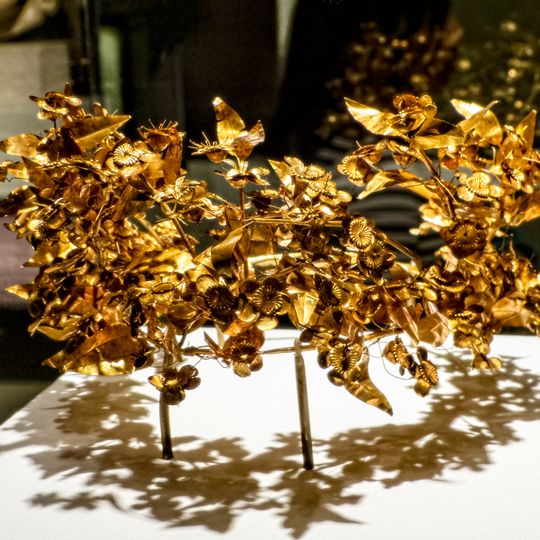
Myrtle wreath at Vergina, Grave good from royal Macedonian tombs in Vergina, Greece
The myrtle wreath is a carefully made ornament made from about 80 leaves and over 110 flowers attached to a cylindrical rod. Each piece was cut from thin gold sheets and engraved by hand.
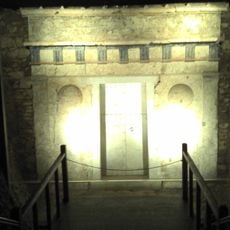
A Greek archaeologist named Manolis Andronikos found this object in 1977 in a burial chamber at Vergina that belonged to a powerful Macedonian king. The discovery dates to a period when such elaborate objects were placed in royal tombs.
In the ancient world, gold wreaths like this one were signs of wealth and rank, worn or placed in tombs during celebrations and burials. Such objects reveal how much value people placed on precious materials and skilled craftsmanship.
The wreath is kept in the Archaeological Museum of Vergina under special conditions to protect the thin gold sheets from damage. Visitors should view this delicate object from a distance and look closely at the details of the fine craftsmanship.
Each leaf and flower on the wreath was individually stamped and carved from thin gold sheets, a technique that was extremely time-consuming and labor-intensive. This method was so demanding that only the wealthiest families could afford to commission such precious objects.
The community of curious travelers
AroundUs brings together thousands of curated places, local tips, and hidden gems, enriched daily by 91,652 contributors worldwide.