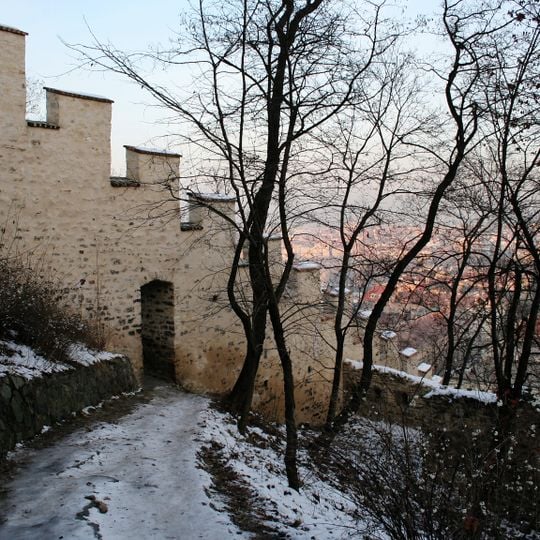
Hunger Wall, Medieval defensive wall in Petrin Hill, Prague, Czech Republic
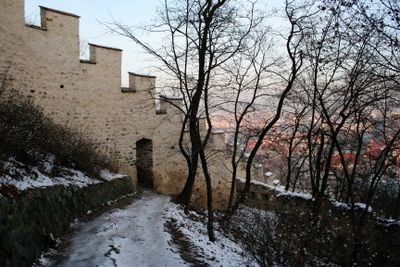
The Hunger Wall is a rough light-beige stone and plaster rampart on Petřín Hill, built from marl quarried on the hill. It originally stood 4 to 4.5 metres high and 1.8 metres wide, with battlements, a walkway, loopholes and probably eight bastions. A dark rectangular gateway with a flat stone lintel opens near its base.
King Charles IV ordered construction of this fortification between 1360 and 1362 to defend Prague from western attacks. The wall formed part of his broader strategy to strengthen the city and its castle.
The wall was first called Zubatá (toothed) or Chlebová (built for bread); the adjective Hladová, "hungry", appeared only after the famine of 1361, when work on the wall gave the city's poor a livelihood. Chroniclers Václav Hájek z Libočan and Bohuslav Balbín record the legend that Charles IV worked on the site in workers' clothes.
The wall can be explored on foot from several access points along the hillside. The best time to visit is in dry weather, as the steep terrain can be slippery at times.
The king himself regularly visited the construction site and changed into workers' clothes to help with the building for short periods. This personal involvement of such a powerful ruler was unusual for the time and was recorded by chroniclers.
The community of curious travelers
AroundUs brings together thousands of curated places, local tips, and hidden gems, enriched daily by 92,365 contributors worldwide.