Dreiherrenstein, Boundary marker in the Ore Mountains, Germany
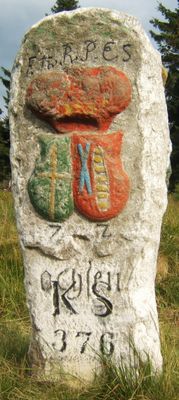
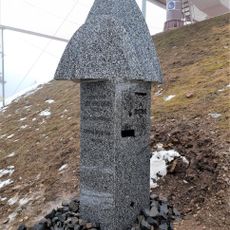
Dreiherrenstein is a triangular stone column about 1.35 metres tall and nearly 300 kilograms in weight, standing at 1,165 metres on the German-Czech border. Its three faces carry reliefs: the Saxon-Polish arms with the letters FARPES, the Hauenstein arms with the year 1729, and the Austrian double eagle for Joachimsthal.
The triangular stone was first erected in 1677 at the Sonnenwirbel as a boundary pillar between the Joachimsthal, Electoral Saxon and Hauenstein domains. In 1729 it received carved coats of arms and the year 1729 when 79 new boundary stones were set along the border. In 1842–43 a boundary ditch was dug and the stone was numbered 376 with the letters KS and KB.
The stone displays carved coats of arms that marked the territories of the ruling powers in this border region. Visitors can still see these symbols today and understand how important such markers were for organizing the land in earlier times.
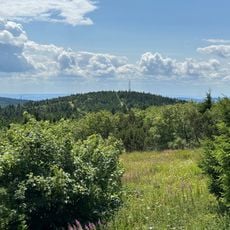
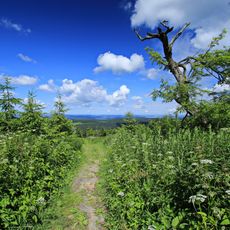
The stone stands at 1,165 m on the state border at the southern edge of the Schlauderwiese nature reserve. The shortest approach is from Boží Dar or Neues Haus via the border crossing road toward Klínovec; after the small power station by the wind turbine, turn left onto a paved path, then follow a trail along the border. The stone is about 1.35 m high and weighs nearly 300 kg.
The stone was carved by a stonecutter from Sankt Joachimsthal, whose craftsmanship is visible in the inscriptions. This local connection to the mining region is reflected in the careful execution of the coat of arms designs.
The community of curious travelers
AroundUs brings together thousands of curated places, local tips, and hidden gems, enriched daily by 93,612 contributors worldwide.