Chapel of the Holy Cross, Baroque chapel in Prague Castle, Czech Republic
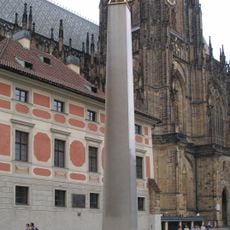
The Chapel of the Holy Cross is a late-baroque chapel on the second courtyard of Prague Castle, built in 1756–1767 by Anselm Martin Lurag to a design by Nicolò Pacassi. Its walls are clad in white marble veined with grey, and since 2012 it has housed the exhibition of the St. Vitus Treasure.
The chapel was built from 1756 to 1767 by the Prague builder of Italian origin Anselm Martin Lurag, to a design by Nicolò Pacassi, court architect of Maria Theresa. It replaced older buildings on the site, including Charles VI's coronation kitchen of 1723, later used as the main guardhouse. In 1852–1856 it was adapted in classicist and historicist style for Emperor Ferdinand V, who had settled at Prague Castle after his abdication in 1848.
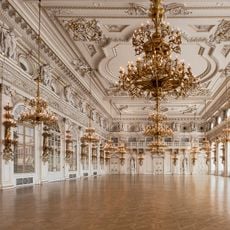
The chapel now serves as the exhibition hall for the St. Vitus Treasure, displayed here since 2012. The altarpiece of the Crucified Christ is by František Xaver Palko, and the angel statues are by Ignác František Platzer. Crystal chandeliers and girandoles came from the Harrachov glassworks.
The chapel is open during regular Prague Castle hours, as it now operates as the castle shop. It sits in the second courtyard, which is easy to reach from the main entrance.
The chapel's interior holds late-baroque work from 1764–1765: walls clad in white marble with grey veining, and a main altar predella of brown Slivenec marble. The baroque paintings by Josef Hager have not survived; the ceiling and wall frescoes are by Vilém Kandler.
The community of curious travelers
AroundUs brings together thousands of curated places, local tips, and hidden gems, enriched daily by 92,145 contributors worldwide.