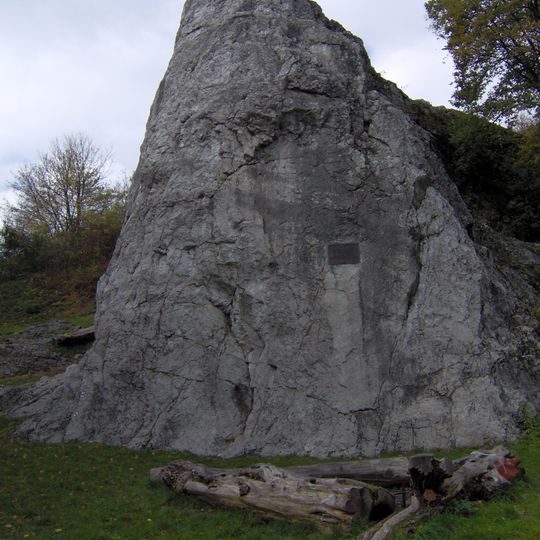
Váňův kámen, Limestone cliff natural monument in Kopřivnice, Czech Republic.
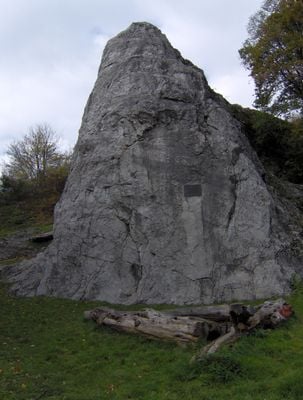
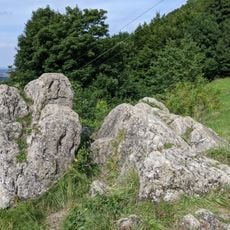
Váňův kámen is a light-grey Jurassic limestone outcrop near Kopřivnice, rising about 20 metres above the surrounding ground. Its walls, shaped by late 19th-century quarrying, form a roughly triangular base 50 by 30 metres, and the rock shows a marked breccia texture with fossils of a former coral reef.
In 1879 Karel Jaroslav Maška found bronze pins and flint knives here, and research later confirmed Púchov culture settlement. In the 17th century up to 1,500 men from 30 villages of the Hukvaldy bishopric estate gathered here during peasant uprisings; a bronze plaque on the southeast wall has marked this since 1995.
The rock's name is not documented in the sources; what is documented is its use. A bronze plaque unveiled on the southeast wall in 1995 commemorates the 17th-century peasant uprisings, in which up to 1,500 men from 30 villages of the Hukvaldy estate took part. Today climbers use the south and southeast faces, where 22 routes are marked.
You can reach the site via marked trails starting from Kopřivnice town and should wear sturdy shoes since the terrain is rocky and uneven. The best time to visit is during dry weather, when the paths are safer to navigate.
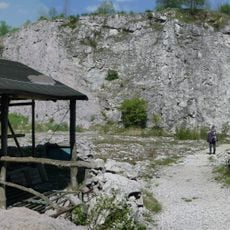
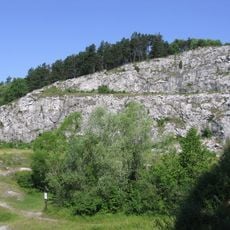
The cliff walls are not natural: they were shaped by limestone quarrying at the end of the 19th century. Climbers now use the south and southeast faces, where 22 routes of lower to middle difficulty are marked, the hardest graded 7+ and 8-.
The community of curious travelers
AroundUs brings together thousands of curated places, local tips, and hidden gems, enriched daily by 92,114 contributors worldwide.